Golden Visa Dubai Through Property: 2026 Guide
Learn how Golden Visa Dubai property investment works, including eligibility value, off-plan checks, documents and when to verify rules.
What the Golden Visa gives a property buyer
The UAE Golden Visa is a 10-year residency permit that renews, and you do not need a local sponsor or an employer to hold it. For a property buyer, that is the appeal: buy a qualifying property and you can live, work and study in the UAE long-term, sponsor your spouse, children and parents, and keep the visa even if you spend more than six months a year outside the country. Income you earn in the UAE is not taxed.
The property route is one of several ways to qualify (others cover talent, skilled professionals and entrepreneurs), but this guide covers the property route only. From here, this guide focuses on one thing: whether your Dubai property can actually support that route, and how to prove it.
Before treating a Dubai property purchase as a Golden Visa route, check the visa path before you commit the capital. The useful question is not only whether the property reaches the value threshold. It is whether the ownership record, payment status, project registration and documents are strong enough to support an application when you need them.
This guide is for buyers whose Dubai property decision is partly driven by the 10-year Golden Visa. It explains the AED 2 million property route, how off-plan and mortgaged property are treated, what documents usually matter, and the checks to complete before relying on the visa outcome. It is part of our wider guide to off-plan property investment in the UAE, focused on the residency angle.
What’s in this guide:
Quick answer:
- The UAE property-investor route is built around one or more properties with a total value of at least AED 2 million, according to the UAE Government Portal.
- Off-plan property can be eligible where it is bought from a locally approved developer and the purchase is properly registered.
- Mortgaged property can be eligible: what counts is the property’s total DLD-certified value, not how much has been paid, provided the lender supplies the evidence the authority requires in its exact format.
- The property condition is only one part of the file. The residency application, medical steps, biometrics, insurance and document checks still sit with the relevant immigration authority.
- The safest approach is to verify the property file with DLD and the visa file with GDRFA Dubai or ICP before paying a reservation fee or signing the SPA.
Data note: Golden Visa eligibility and document requirements are set by the issuing authorities and can change. This guide is for buyer education and does not replace legal advice or official immigration guidance on a specific application. It references official UAE and Dubai sources accessed for a 2 June 2026 update; buyers should confirm live requirements with GDRFA Dubai or ICP before applying.
First check: does the property meet the AED 2 million threshold?
The property-investor route is based on owning one or more properties with a total value of at least AED 2 million. That distinction matters. The official wording refers to the value of one property or a group of properties, so a buyer with several qualifying properties may be able to add them together.
For a buyer, the practical test is simple: can the AED 2 million value be proved through documents the authority will accept? A signed reservation form or sales brochure is not enough on its own. The file needs official evidence of the property, the buyer’s registered interest and the value being relied on.
For Dubai property, the property side is evidenced through Dubai Land Department records and registration documents. The residency side is assessed through GDRFA Dubai, ICP or the relevant immigration channel. Keep those two tracks separate. A property can look attractive commercially and still need more paperwork before it supports a residency application.
If the visa is central to the purchase, confirm the threshold and document path before committing. That check is especially important for off-plan, financed or jointly owned property.
Can off-plan property support a Golden Visa application?
Yes, official UAE guidance allows off-plan property to be considered where the unit is bought from a locally approved real estate company and the total value condition is met. The buyer does not need to wait for handover, and, since the old upfront-payment rule was removed, does not need to have paid a minimum share of the price either; what counts is the property’s total certified value. The purchase does still need to be properly registered and supported by the right documents.
For Dubai off-plan property, the key buyer question is whether the project and sale are registered in a way that can be evidenced. In practice, that means checking the DLD-side registration status and making sure the developer can provide the documents needed for the residency file.
Before relying on an off-plan unit for the Golden Visa route, ask for written confirmation of:
| Check | Why it matters |
|---|---|
| Project registration | The project should be visible through official Dubai registration channels. |
| Developer approval | The official route refers to purchases from locally approved real estate companies. |
| Initial sale registration | The buyer needs more than a reservation form; the purchase should be properly registered. |
| Value evidence | The AED 2 million threshold must be supported by documents the authority accepts. |
| Application timing | The developer’s paperwork timetable should match the buyer’s visa timetable. |
The Dubai Land Department’s Project Status Enquiry is a useful starting point for checking whether a project is registered and how its status is recorded. It is not a substitute for immigration approval, but it helps a buyer avoid relying on a project file that is not ready.
Can mortgaged property qualify?
Yes. The official conditions accept a mortgaged property, and what counts is the property’s total value as certified by the Dubai Land Department, not how much you have paid so far.
This is a real change worth understanding. Earlier rules required a mortgaged or instalment buyer to have already paid a large share before they could qualify: a minimum of AED 1 million, or 50% of the value. That upfront-payment barrier has since been removed: the official conditions now turn on the property’s total certified value, not how much you have paid. A property worth AED 2 million can qualify whether you have paid 10% or 90%, provided the certified value meets the threshold and the lender provides the evidence the authority requires.
The one part still worth confirming is the exact bank mechanism. The public eligibility pages say a mortgaged property is acceptable, but they do not spell out the precise documentation. Reported requirements include a no-objection letter, or a bank guarantee covering the full value, in a format the authority prescribes exactly. Because the wording must match that format or the file is rejected, confirm the current requirement with GDRFA Dubai or ICP and your bank before you rely on a mortgaged purchase.
Before choosing a mortgage-led route, confirm three points in writing:
- exactly what the bank will issue (a no-objection letter, a full-value bank guarantee, or both) and in which authority-approved format;
- that the property’s certified value clears AED 2 million;
- that the timing of the mortgage, DLD registration and residency application works together.
Which documents usually prove the property position?
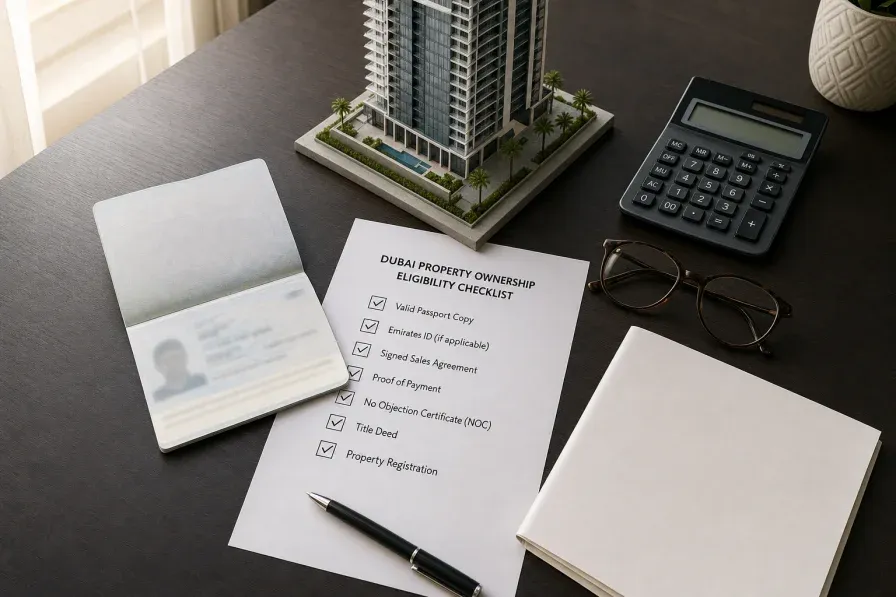
The documents answer four practical questions: does the property exist in the official records, who owns or holds the registered right, what value is being used, and whether a lender is involved.
For a completed Dubai property, the DLD title deed is usually the central ownership document. It proves that the property is registered and shows the buyer’s ownership position.
For off-plan property, the buyer will usually rely on the initial sale registration, often described in Dubai as Oqood-style registration, together with developer documents and any authority-requested proof of value. The exact document names and acceptable formats should be checked at the time of application.
For mortgaged property, the bank’s no-objection letter sits alongside the property registration documents. If the property is jointly owned, the authority may also need to confirm how much of the property value counts toward the applicant.
A practical buyer rule: do not treat the document list as fixed until the application channel confirms it. Names, upload formats and evidence requirements can change. What worked for a previous buyer may not be enough for a new file.
For a step-by-step walk through the documents themselves (how Oqood, the title deed, the SPA, payment receipts and the bank no-objection letter fit together), see Golden Visa Property Documents in Dubai: Oqood, SPA & Evidence Explained.
How the Dubai application sequence usually works
The application sequence is best viewed as a set of checkpoints rather than a guaranteed timeline. The order may vary by channel, but the logic is usually the same.
- Prepare the property file. Confirm the title deed, initial sale registration, developer documents, mortgage letter and value evidence, depending on the property’s stage.
- Check the authority route. Confirm whether the application should be submitted through GDRFA Dubai, ICP or another approved channel.
- Submit the residency application. Upload the required documents and complete the authority’s application steps.
- Complete medical and biometric requirements. These are part of the residency process where required.
- Provide insurance evidence. Comprehensive health insurance for the investor and family is part of the Golden Visa route.
- Receive the decision and issuance. The 10-year Golden Visa is issued where the authority accepts the application and conditions are met.
The key planning point is timing. A buyer who needs the visa quickly should not assume that an off-plan purchase will produce every document immediately after reservation. Ask the developer, bank and authority what can be issued, when it can be issued and in what format.
How to keep the property decision sound
The Golden Visa can be an important benefit, but the property still needs to work as a property. A residency-led buyer should check the same fundamentals as any Dubai buyer: area demand, service-charge exposure, payment-plan cash flow, handover timing, developer documentation and resale liquidity.
That does not mean the visa route is weak. It means the visa should sit on top of a purchase that already makes sense. A property bought only to reach the threshold can create pressure later if the buyer needs to sell, refinance or cover holding costs.
Use this simple filter before committing:
| Buyer question | What to check before paying |
|---|---|
| Would I hold this property without the visa? | Area quality, tenant demand, building type and likely service charges. |
| Can I prove the value? | Official registration, title or initial sale evidence, and any required valuation proof. |
| Is the project file clean? | DLD project status, escrow/payment instructions and developer documentation. |
| Does the payment plan match my cash flow? | Down payment, instalment dates, handover payments and contingency cash. |
| Can I exit if my plans change? | Assignment rules, mortgage position, resale demand, developer NOC process, and keeping qualifying property worth at least AED 2 million if you want the visa to continue. |
The strongest position is to choose a property you would be comfortable holding even if the visa were incidental. Then the residency outcome becomes an added benefit rather than the whole reason for the purchase.
The bottom line
Dubai property can support a Golden Visa application when the total value reaches at least AED 2 million and the ownership evidence is accepted by the authority. Off-plan and mortgaged properties can both have a route, but the route depends on registration, developer approval, lender documentation and the live requirements of GDRFA Dubai or ICP.
Before committing, check the property file with DLD records, confirm the document path with the developer or bank, and verify the residency route with the issuing authority. The visa decision should be planned before purchase, not discovered after the SPA is signed.
Frequently asked questions
Is the Dubai Golden Visa property threshold based on purchase price, market value or equity?
Official guidance frames the route around owning one or more properties with a total value of at least AED 2 million. It is best treated as a value-and-documentation test rather than a simple headline purchase-price test. Confirm how your specific property value will be assessed with GDRFA Dubai or ICP before applying.
Can I apply for a Golden Visa with an off-plan Dubai property before handover?
Yes. Off-plan property can be considered where it is bought from a locally approved real estate company and the certified value meets AED 2 million. Since the old upfront-payment rule was removed, you do not need to have paid a minimum share first; what counts is the property’s total certified value. The practical issue is whether the purchase is properly registered and the documents are ready for the visa file.
Does a mortgaged Dubai property count for Golden Visa eligibility?
A mortgaged property can qualify. Eligibility now turns on the property’s total DLD-certified value rather than a minimum amount paid, so the old requirement to have paid AED 1 million or 50% upfront no longer applies. The lender must still provide the evidence the authority requires, reported to include a no-objection letter or a full-value bank guarantee in a prescribed format, so confirm the exact current requirement with the bank and the issuing authority before relying on it.
Can joint owners or spouses combine Dubai property values?
The official route allows one or more properties to meet the AED 2 million value condition. How a jointly owned property is counted for one applicant can depend on the ownership share and authority assessment, so co-owners should verify the treatment before committing.
Do I need a Dubai title deed before applying?
A completed property usually relies on the DLD title deed. An off-plan purchase may rely on initial sale registration and developer documents before title deed issuance. The acceptable proof depends on the property’s stage and the current authority document list.
Can I sell the property and keep my Golden Visa?
Yes. There is no minimum holding period in Dubai. But the visa is tied to continuously owning qualifying property worth at least AED 2 million. If you sell, the Dubai Land Department will not complete the transfer unless you can show you still hold other qualifying property that meets the threshold. Sell without replacing it, so your holdings drop below AED 2 million, and the Golden Visa is cancelled. Sell while keeping or substituting other property that still clears AED 2 million, and the visa continues. Plan any sale around that condition rather than after it.
Should I buy Dubai property mainly to qualify for the Golden Visa?
Treat the Golden Visa as a benefit of a sound property decision, not the only reason to buy. The better approach is to choose an asset that fits the buyer’s budget, holding period and exit plan, then use the visa route as part of the wider decision.
Sources and useful references
- UAE Government Portal: Golden Visa information
- Dubai Land Department: Real Estate Project Status Enquiry
- GDRFA Dubai: Golden Residency for investors
- ICP: Golden Residency
Browse current Dubai off-plan projects on Projectory to check area, developer, starting price, payment plan and handover date before shortlisting →