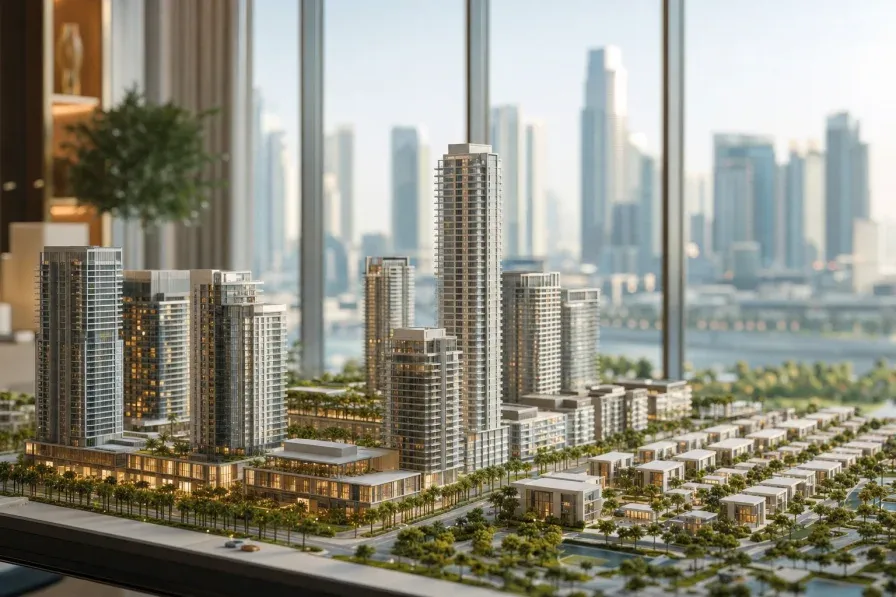
Capital Appreciation in Dubai Off-Plan Property
Learn how Dubai off-plan capital appreciation works, what drives price uplift before handover and which signals investors should verify before buying.
Capital appreciation in Dubai off-plan property is not a promise of price growth. It is a timing-and-exit question: when does the uplift appear, and can the buyer turn it into cash when needed?
A launch price that looks attractive beside future expectations can still disappoint if the unit cannot be resold at handover, if competing supply is heavy, or if a large final instalment forces a sale into a slower market. The investors who do well treat appreciation as a decision framework: entry-price discipline, community delivery, resale liquidity and payment-plan timing.
What’s in this guide:
Quick answer:
- Dubai off-plan property can appreciate before or after handover, but the gain is only real when there is a buyer at the exit.
- The first test is whether the launch price is genuinely below comparable completed stock, not whether the brochure shows a headline discount.
- Off-plan earns no rental income during construction, so capital growth has to carry the holding period until handover or resale.
- A handover-heavy payment plan can strengthen cash-flow flexibility during construction, but it also concentrates pressure at completion.
- Stress-test appreciation against fees, a 12-month delay, softer rents after handover and no pre-handover resale premium.
Data note: This guide uses public market reporting available at the time of writing, including Gulf News coverage of Q1 2026 Dubai sales and ValuStrat commentary published via Zawya. This guide is for buyer education and does not replace legal, tax or investment advice on a specific purchase.
Where Dubai off-plan price uplift can happen
Capital appreciation on a Dubai off-plan unit can appear in three windows.
The first is launch-to-construction resale, where an investor assigns the contract to a new buyer before completion. The second is construction-to-handover repricing, where the unit’s market value moves as the building progresses and comparable transactions develop. The third is post-completion value, when the building is usable, the community is more complete and end users start setting the price alongside investors.
This is different from rental yield. Rental income starts only after handover, while off-plan property earns no rent during construction. It is also different from total ROI, which blends capital growth, rent and costs. Capital appreciation is simply the change between entry price and exit price.
Dubai’s market has had strong transaction momentum. Gulf News reported Dubai property sales of AED 176.7 billion in Q1 2026 — an emirate-wide quarterly sales value, not a project or unit price — with off-plan demand contributing heavily to activity. That supports the case for liquidity at entry, but the appreciation question is narrower: who buys this unit from the investor, at what price, and at what point in the payment schedule?
The entry-price test: compare with completed stock
The first appreciation test is whether the launch price genuinely sits below comparable completed property.
A launch is not automatically undervalued because it is new, branded or marketed with an early-buyer price. The comparison has to be narrow: same area, similar size band, similar view, similar quality level and a realistic handover horizon. If completed stock nearby already trades at the same level, the buyer is not purchasing a discount. They are purchasing a future expectation.
This is where investors should avoid broad averages. A one-bedroom in a mature tower cluster, a branded waterfront apartment and a suburban townhouse all have different exit buyers. The useful question is not whether Dubai is rising in general. It is whether this specific unit has a gap to close between the off-plan entry price and the completed-market value that a future buyer is likely to accept.
For a fuller cost-and-return model, use this article alongside Projectory’s guide to ROI on off-plan property in Dubai.
Masterplan delivery changes the exit value
A project can be worth more at completion when the surrounding community becomes easier to live in. Roads, retail, schools, public realm, beach or waterfront access, transport links and neighbouring handovers can widen the buyer pool from mainly investors to a mix of investors, tenants and end users.
That matters because end users pay for daily life, not just a render. A unit completing around the same time as meaningful community infrastructure may have a deeper resale market than a similar unit in an area where key amenities are still several years away.
Established districts such as Downtown Dubai and Business Bay already have deep end-user and tenant demand. Newer masterplans may offer more room for appreciation, but the case depends on whether the promised community milestones arrive close to the investor’s exit window.
Zawya reported that Dubai recorded more than 270,000 real estate transactions in 2025. That level of activity is positive for market depth, but it does not remove the need to judge each community by delivery stage, competing supply and buyer demand. To compare community profiles, the guide to the best areas to buy off-plan property in the UAE is a useful starting point.
Supply depth decides whether paper gains are usable
A paper gain is not the same as an exit. The unit still needs a buyer at the price and timing the investor needs.
This is especially important in segments with heavy future supply. If several similar towers, layouts and handover dates are competing for the same buyer pool, resale may take longer even if headline prices look firm. Differentiated stock usually has a clearer exit story: a stronger view, a scarce layout, a mature location, larger floor plan, better parking position or a completion date that avoids a crowded handover window.
ValuStrat’s 2026 outlook, published via Zawya, forecasts residential capital growth moderating to around 10% for the year, down from 19.8% in 2025, with apartments (about 7.4%) expected to rise more slowly than villas (about 17.7%). The lesson is not that investors should avoid off-plan property. It is that the recent pace of growth is slowing, and is uneven across segments, so a buyer relying on a quick resale at a particular moment should plan for a slower or softer exit than the headline market suggests.
Before relying on appreciation, ask three questions:
| Question | Why it matters |
|---|---|
| How many similar units complete around the same time? | Heavy same-segment supply can slow resale. |
| Who is the likely exit buyer? | Investors, tenants and end users value different features. |
| Can the buyer hold through a slower market? | Flexibility reduces pressure to accept a weak exit price. |
Model appreciation after fees and delays
A simple example shows why gross appreciation can look stronger than the final result.
Assume an investor buys an off-plan apartment for AED 2,000,000 and later believes it can be resold for AED 2,200,000. The gross capital uplift is AED 200,000, or 10% before costs.
That is not the investor’s net outcome. Carry the same example through the costs that actually apply to a pre-handover assignment:
| Item | Amount |
|---|---|
| Resale (assignment) price | AED 2,200,000 |
| Purchase price | (AED 2,000,000) |
| Gross gain | AED 200,000 |
| DLD transfer fee (4% of the AED 2,000,000 purchase) | (AED 80,000) |
| Resale agency fee (typically around 2% of the resale price) | (AED 44,000) |
| Assignment, NOC and admin (developer-set; illustrative, confirm per project) | (AED 10,000) |
| Net gain before any financing or holding costs | ≈ AED 66,000 |
That turns a 10% paper gain into roughly AED 66,000 — about 3% on the capital committed — and that is before financing costs, and before service charges, maintenance and vacancy if the buyer completes and holds the unit rather than assigning it. The 4% DLD fee is fixed; the agency and assignment figures are typical amounts to confirm on the specific deal. The point is not the exact total. It is that a headline 10% can land near 3% once entry and exit costs are real, so appreciation has to be judged net, not gross.
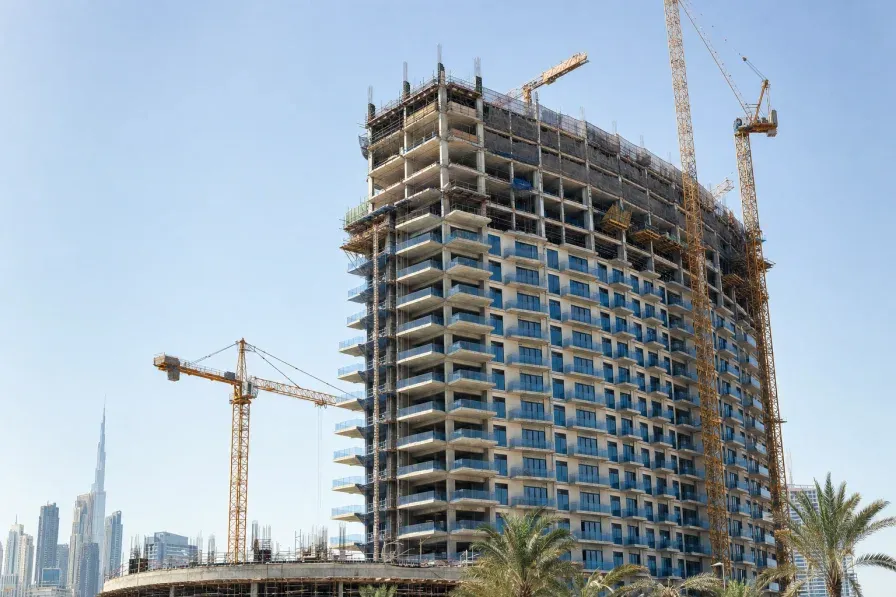
The holding period matters too. During construction, there is no rental income. If handover is delayed by 12 months, the investor waits longer to earn rent or complete an end-user resale. If rents are 15% softer than expected after handover, the fallback rental case is weaker. If there is no pre-handover resale premium, the investor must be comfortable completing the purchase rather than depending on assignment.
A good appreciation case therefore has two exits: the preferred exit, and a workable fallback if the preferred exit is not available.
Payment-plan timing can change the strategy
Payment structure decides how much pressure the investor faces at each stage.
A front-loaded plan spreads cash commitment through construction. A handover-heavy plan preserves more cash during the build, but it concentrates a larger payment at completion. That can work well for a buyer with committed funds or financing. It is less comfortable for a buyer who needs to resell before the final payment is due.
Mr C Residences Downtown is a useful example of a handover-heavy structure because its listed plan includes a large final instalment at handover. The point is not a verdict on that project. It is a reminder that appreciation strategy and payment plan should be read together. If the market is slow around handover, a buyer who can complete has more options than a buyer who must sell.
Developer execution should be verified, not assumed
Developer execution affects capital appreciation through construction progress, handover confidence, specification delivery and the resale buyer’s willingness to pay for the finished product. But a brand name is not evidence of future price growth on its own.
The practical approach is verification. Check construction progress against the stated handover date. Read the specification in the SPA rather than relying only on marketing material. Visit a show unit or a completed building by the same developer where possible. Cross-check the project’s registration and status through the DLD Project Status Enquiry tool and review the developer through official RERA channels before reserving.
Two projects from the same developer can perform differently if they complete into different supply conditions, communities and buyer pools. Judge the specific unit, building, payment plan and exit timing.
The bottom line
Capital appreciation in Dubai off-plan is earned at the exit, not promised at launch. The strongest cases combine a real gap to completed stock, a community with delivery milestones near handover, a resale market deep enough to absorb the unit and a payment plan that does not force the buyer to sell at the wrong moment.
ValuStrat’s moderating-growth outlook is a useful reminder that entry momentum and exit liquidity are separate. A disciplined buyer plans for the upside case, then checks whether the purchase still works if resale is slower, handover is later or the rental fallback is softer than expected.
Frequently asked questions
Can Dubai off-plan property appreciate before handover?
Yes. Value can rise between launch and handover and may be realised through assignment, where the buyer sells the contract to another buyer before completion. This usually depends on the developer’s assignment rules, NOC requirements, minimum payment thresholds and resale demand for that unit type.
Is capital appreciation the same as ROI on Dubai off-plan property?
No. Capital appreciation is the change in price between entry and exit. ROI includes appreciation, rental income after handover and costs such as DLD fees, registration costs, service charges, vacancy, management, maintenance and financing costs where relevant.
What launch-price discount is enough?
There is no fixed percentage. The test is whether the launch price is below comparable completed stock with similar location, size, view, quality and timing. If similar finished units already trade at or below the launch price, there may be no real gap to close.
How does a large handover payment affect capital appreciation?
A large final instalment concentrates the buyer’s commitment at completion. The strategy works best when the buyer can complete, refinance or resell without pressure. If resale demand is slow at that point, the buyer has fewer choices.
Does rental demand matter for a capital-growth buyer?
Yes. Rental demand widens the exit market because yield-focused investors can compete with end users. If rental demand is shallow, resale may depend more heavily on speculative buyers, who can be less active in slower periods.
Sources and useful references
- Gulf News. Dubai Property Sales Hit Dh176.7 Billion in Q1 2026
- ValuStrat via Zawya. Dubai Real Estate Outlook 2026
- Zawya. Dubai recorded over 270,000 real estate transactions worth AED 917bln in 2025
- Dubai Land Department. Real Estate Project Status Enquiry
Browse current Dubai off-plan projects by area, developer, starting price, payment plan and handover date on Projectory to test entry price and exit timing across communities →