ROI on Off-Plan Property in Dubai: Current Projects, Prices & Track Record
Understand ROI off-plan property Dubai with current price signals, project depth, rent logic and risk checks before comparing new launches today.
Most Dubai off-plan investors do not lose money because they misunderstand the headline price. They lose confidence in the investment case because they model ROI from the brochure, not from the cash flow. A launch that advertises 8-10% gross rental ROI can look very different once the 4% DLD fee, Oqood registration, service charges, vacancy, maintenance, mortgage costs, assignment fees and handover timing are included.
This guide is for investors comparing Dubai off-plan projects and trying to calculate realistic ROI before signing an SPA. It separates gross yield from net yield, rental income from capital appreciation, and short-term assignment profit from long-term hold returns. Projectory’s UAE off-plan investment guide provides the wider framework for payment plans, project verification and exit routes. The goal here is simple: build a shortlist around the cash that can realistically land in your account, not the return percentage printed in a launch brochure.
What’s in this guide:
Quick answer:
- Realistic net rental ROI: Many Dubai off-plan apartments that advertise 7-10% gross rental yields are closer to 5-6% net once operating costs, vacancy and purchase fees are included.
- ROI has three parts: capital appreciation during construction, possible pre-handover resale via assignment, and post-handover rental income.
- Biggest modelling mistake: Treating a future rental yield as if it applies during construction. Off-plan property earns no rent until handover and lease-up.
- Most important stress test: Model a 12-month handover delay, 15% lower rent than expected and full buyer responsibility for the 4% DLD fee.
- Walk away if: The advertised ROI is not clearly labelled as gross or net, or the seller cannot explain service charges, payment-plan burden and exit costs.
Data note: Market figures in this article reference the latest available public reports at the time of writing, including Cavendish Maxwell, ValuStrat, DXB Interact and Dubai Land Department service information. Real estate data changes quickly, so verify project-specific pricing, service charges, payment plans, handover dates and SPA terms before committing. This guide is for buyer education and does not replace legal, tax or investment advice on a specific purchase.
Key takeaways:
- A brochure yield is usually gross rental yield, not net ROI. It often excludes service charges, vacancy, management, maintenance, DLD fees and exit costs.
- On a AED 1.5M apartment marketed at 8% gross yield, realistic net rental ROI can fall to around 5.7% after service charges, vacancy, management, maintenance and the 4% DLD fee.
- Off-plan ROI should be modelled in three stages: construction-stage appreciation, assignment resale before handover and post-handover rental income.
- Dubai’s Q1 2026 market remained active, with Cavendish Maxwell reporting AED 139.1 billion in residential sales and off-plan transaction volume up 10.5% year-on-year.
- The safest ROI comparison is not “which project advertises the highest yield?” It is “which project still works after fees, delays, softer rent and exit costs?”
For the full Dubai off-plan buying process, from reservation through SPA review, payment plans and handover, read the complete guide to off-plan property in Dubai.
What ROI on Dubai off-plan property really means
ROI on Dubai off-plan property is not one number. It is the combined result of purchase price, payment timing, capital growth, rental income, costs and exit route.
That distinction matters because most marketing material compresses all of those moving parts into a single attractive percentage. A brochure might say “8% ROI” or “10% expected return,” but the investor needs to know what the figure includes. Is it gross rental yield at handover? Is it a projected annual return after costs? Is it based on today’s rents, future rents or comparable completed buildings? Is it assuming resale before handover?
For an investor, the cleanest way to model off-plan ROI is to separate it into three questions:
The mistake is adding these together too casually. A project can appreciate 10% during construction and later produce a 6% rental yield, but that does not mean the investor has earned “16% ROI.” Capital gain is realised only when the unit is sold. Rental yield begins only once the property is delivered, handed over and leased.
How gross ROI becomes net ROI after fees and costs
Gross ROI is the marketing number. Net ROI is the number investors should use to compare projects.
The basic formula is:
Net rental ROI = annual rent received minus annual operating costs, divided by total acquisition cost.
That means the denominator is not just the purchase price. It should include purchase costs such as the 4% DLD fee, Oqood or registration-related charges, trustee/admin costs where applicable and any mortgage registration costs if the property is financed. The numerator should reflect the rent that actually lands after service charges, vacancy, property management and maintenance.
A simple example shows the difference.
Assume an off-plan apartment is purchased for AED 1,500,000 and is marketed at 8% gross rental yield after handover.
The brochure number is not false. It is just incomplete. The 8% gross yield becomes 5.7% net once normal operating costs are included.
ROI rule: Any Dubai off-plan project advertised with a yield should be recalculated using total acquisition cost and net annual rent. If the ROI only works before costs, it does not work.
This is also why the 4% DLD fee matters so much. It is paid upfront, but it affects your return for the full holding period because it increases the cash invested before the property generates income.
For a deeper breakdown of how the 4% registration cost works, read the guide to DLD fees for Dubai off-plan property.
How off-plan projects generate ROI before handover
Off-plan property can generate value before handover, but it does not generate rent before handover.
Construction-stage appreciation is the first potential return. It happens when a unit bought at launch becomes more valuable as the project sells, construction progresses or the surrounding area matures. This is most credible when the launch price is below comparable completed stock, the area has clear demand, and the handover pipeline is not overloaded with similar units.
Pre-handover resale through assignment is the second route. Many Dubai developers allow buyers to transfer the SPA to another buyer once a required percentage of the purchase price has been paid. In many cases this threshold sits somewhere around 30-45%, but the exact rule varies by developer, project and SPA. The NOC fee and assignment process should be checked before booking, not when the investor wants to exit.
For example, assume an investor buys a unit for AED 2,000,000 and pays 40%, or AED 800,000, during construction. If the unit can later be assigned at AED 2,300,000, the new buyer takes over the remaining AED 1,200,000 owed to the developer. The original buyer’s gross profit before fees is AED 300,000 on AED 800,000 deployed.
That looks attractive, but it is not risk-free. The investor still needs buyer demand at the time of exit, developer consent, a clean NOC process and enough market premium to cover DLD-related costs, agency costs if applicable and any developer assignment fees.
Post-handover rental income is the third route. It is also the only route that creates recurring cash flow. During the construction period, the investor is paying instalments with no rental income. Any ROI model that uses post-handover rent without accounting for two to four years of zero income is overstating the annualised return.
What 2026 market signals mean for off-plan ROI
Dubai’s 2026 market signals do not say “avoid off-plan.” They say investors should stop assuming straight-line appreciation.
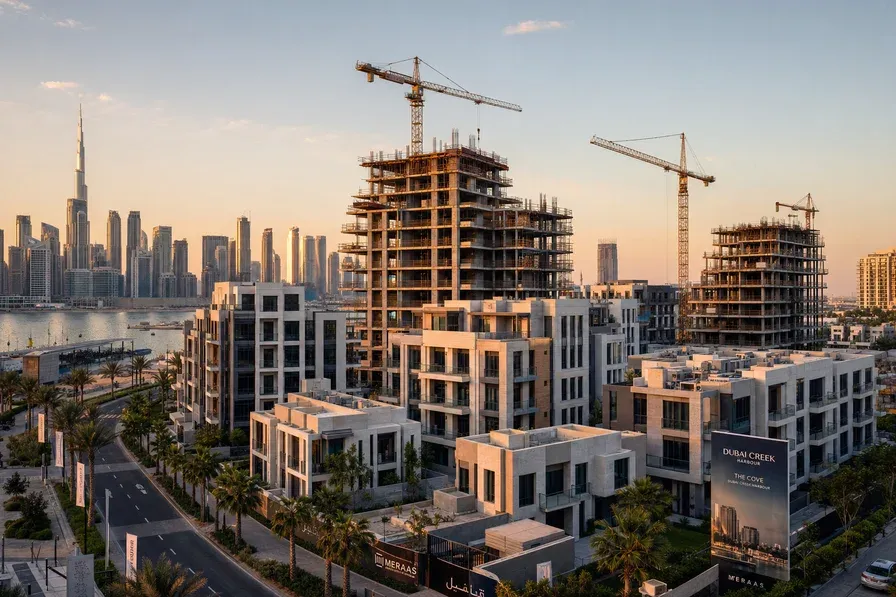
Cavendish Maxwell reported approximately 44,200 Dubai residential transactions worth AED 139.1 billion in Q1 2026, with off-plan transaction volume up 10.5% year-on-year. That confirms off-plan demand remained active despite a more volatile quarter.
At the same time, ValuStrat’s March 2026 Dubai Residential Price Index recorded citywide capital values at 229.2 points, down 5.9% month-on-month while still up 8.9% annually. That combination is important. Annual growth remained positive, but the monthly decline showed that two-way price risk had returned.
For ROI-focused buyers, the practical conclusion is this: do not use 2024-2025 appreciation as the default assumption for every project bought in 2026. Use it as historical context. Then stress-test the project under a slower-growth scenario.
The investor who wins in this environment is not the one who chases the highest quoted yield. It is the one who buys with enough margin for slower rent growth, delayed handover and a less liquid assignment market.
Which Dubai areas should ROI-focused buyers compare?
ROI-focused buyers should compare areas by liquidity, rent depth, handover supply and entry price rather than headline yield alone.
At the time of writing, the live project catalogue includes deep off-plan supply in Dubailand, Town Square, Dubai South, Jumeirah Village Circle, Dubai Hills Estate, Dubai Investment Park and Business Bay. Deep supply gives investors more comparison points, but it also increases the need to check how many similar units will complete around the same time.
This table is deliberately qualitative. Area-level yield claims can be misleading if they are based on completed stock, old rental data or competitor portal estimates. The right use of area data is not to declare a winner. It is to identify the risks that need checking before choosing a project.
A JVC studio and a Business Bay one-bedroom can both be rational investments, but for different reasons. JVC may offer a lower entry point and broad rental demand. Business Bay may offer stronger central liquidity and faster resale visibility. Dubai South may suit a longer-horizon buyer who is comfortable waiting for infrastructure-led demand to mature.
Browse current Dubai off-plan launches by area, developer, starting price and handover date on Projectory to compare area positioning before building a shortlist.
What developer and payment-plan checks protect ROI?
Developer delivery and payment-plan structure can protect or destroy ROI before rental yield ever matters.
At the time of writing, the live developer catalogue includes major pipelines from Emaar, Binghatti, Sobha Realty, Aldar, DAMAC, Nshama and Ellington. A deeper pipeline gives buyers more completed and under-construction projects to audit, but project count is not a guarantee of timely delivery.
The checks that protect ROI are specific:
Payment plans deserve special attention because they affect both cash flow and return on cash deployed. A 10/40/50 post-handover plan reduces pre-handover cash pressure but leaves obligations after completion. A 10/70/20 plan requires far more capital before handover but creates a smaller completion balance. Neither is automatically better.
The key is to compare like-for-like. Ask whether the same unit is cheaper on a shorter payment plan. If an extended payment plan is priced 5-10% higher than a standard plan, the “interest-free” benefit may already be built into the purchase price.
The headline yield gets buyers into the door. The payment plan, service charges and delivery record determine whether the yield ever shows up in the account.
Practical ROI checklist before comparing off-plan projects
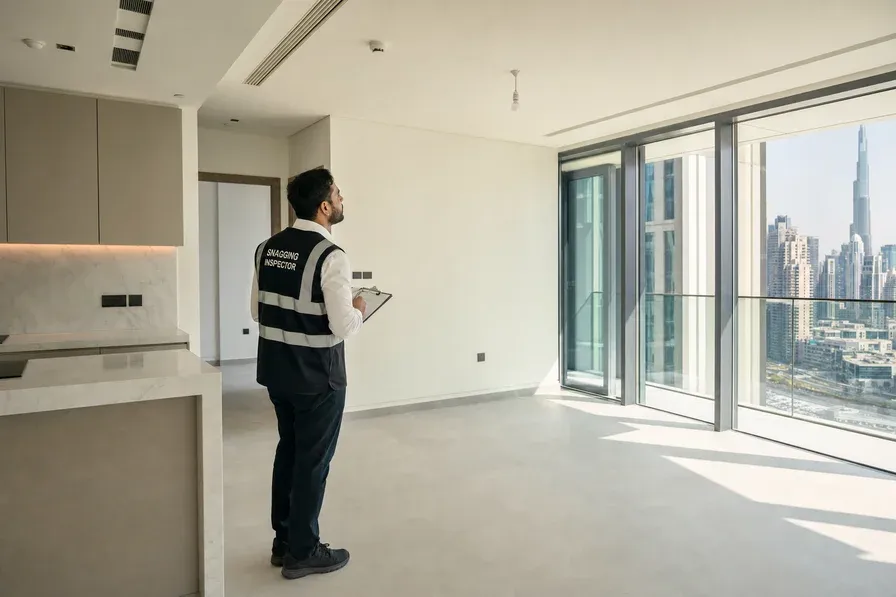
Before comparing Dubai off-plan projects, build the ROI model from the bottom up: acquisition cost, cash deployed, delay risk, net rent and exit route.
Before signing the SPA, verify in writing:
- Whether the advertised ROI is gross or net
- Service charge estimate per sqft per year
- Whether the 4% DLD fee is waived, split or fully payable by the buyer
- Oqood / Initial Sale registration cost and timing
- Total cash required before handover, not just the down payment
- Mortgage eligibility assumptions if financing the handover balance
- Assignment threshold, NOC process and assignment fee
- Handover date and late-delivery remedy clause
- Comparable completed rents, not only brochure projections
- Similar projects delivering within 6-12 months of your handover date
Then stress-test the investment.
Use three downside cases:
If the project still clears a realistic net return under those scenarios, it is a defensible shortlist candidate. If the investment only works with perfect timing, full advertised rent and easy resale before handover, the margin of safety is too thin.
Frequently asked questions
What is a realistic ROI for off-plan property in Dubai after fees?
A realistic net rental ROI for many Dubai off-plan apartments is around 5-6% after service charges, vacancy, management, maintenance and purchase costs. Gross brochure yields may be higher, often in the 7-10% range. The exact result depends on purchase price, rent, service charges, vacancy and whether the DLD fee is waived.
Does ROI on Dubai off-plan property mean rental yield or capital appreciation?
It can mean both, but they should be measured separately. Rental yield is recurring income after handover and lease-up. Capital appreciation is only realised when the unit is sold or assigned. A proper ROI model should show rental yield, capital gain and cash deployed as separate lines.
How does a handover delay affect off-plan ROI?
A handover delay reduces ROI because the investor keeps paying instalments while rental income remains zero. A 12-month delay can remove one year of expected rent and may also push the unit into a more competitive handover window. That is why every off-plan ROI model should include a delay stress test.
Is a 10% ROI claim on a Dubai off-plan apartment usually gross or net?
It is usually gross unless the developer or seller clearly says otherwise. Gross yield normally excludes DLD fees, Oqood, service charges, vacancy, property management, maintenance and exit costs. Ask for the full calculation in writing before relying on any advertised ROI figure.
Can I make ROI by selling off-plan before handover?
Yes, but only if the SPA allows assignment, the required payment threshold has been met and there is enough buyer demand at the time of exit. Assignment profit depends on the resale premium after costs. Do not rely on pre-handover resale as the only way the investment works.
Which Dubai areas should ROI-focused off-plan buyers compare first?
Compare at least one central liquidity area, one mid-market rental area and one growth corridor before shortlisting. For example, Business Bay, Jumeirah Village Circle and Dubai South represent different ROI profiles. The goal is not to find the highest headline yield, but the best risk-adjusted return.
How can I check whether a payment plan is reducing my real ROI?
Compare the same unit or similar units on shorter and longer payment plans. If the extended plan carries a higher purchase price, that premium reduces your capital gain and raises your cost basis. Interest-free does not always mean free; the cost may be built into the price.
Sources and useful references
- Cavendish Maxwell. Dubai Residential Market Performance FY 2025
- Cavendish Maxwell. Dubai Residential Market Performance Q1 2026
- ValuStrat. ValuStrat Price Index Dubai Residential March 2026
- DXB Interact. Dubai transaction data
- Dubai Land Department. Property Sale Registration
- Dubai Land Department. Request to Register the Initial Sale
Also read: Off-Plan Property Under AED 1 Million in Dubai — full-band project examples and payment-plan cash-flow checks under AED 1 million.
Final verdict: brochure ROI is the start, not the answer
A Dubai off-plan project is not attractive because the brochure shows a high yield. It is attractive if the numbers still work after the 4% DLD fee, Oqood, service charges, vacancy, handover delay risk and exit costs are included.
The best off-plan investors do not ask, “what ROI is advertised?” They ask, “what net return survives if handover is late, rent is softer and I cannot resell before completion?”
Browse current Dubai off-plan projects by area, developer, starting price, payment plan and handover date on Projectory to build a shortlist using the ROI framework in this guide.
Also read: Capital appreciation off-plan Dubai
Also read: Golden Visa Dubai Through Property: 2026 Guide
Also read: How to Build an Off-Plan Property Portfolio in the UAE
Also read: Off-Plan Property Tax Benefits: Why the UAE Draws Investors
Also read: Common Off-Plan Mistakes in Dubai and How to Avoid Them
Also read: Dubai Off-Plan Mortgage: Which Banks Lend and What It Costs
About the Projectory Team
Projectory’s editorial content is created and reviewed by its founders, who bring more than 30 years of combined experience brokering, buying, developing and selling property in the UAE.
In this guide series
- Buying GuidesDubai Off-Plan Mortgage: Which Banks Lend and What It Costs
- Investment & ReturnsHow to Sell Dubai Off-Plan Property Before Handover: Assignment Sales Explained
- Buying GuidesCommon Off-Plan Mistakes in Dubai and How to Avoid Them
- Investment & ReturnsOff-Plan Property Tax Benefits: Why the UAE Draws Investors
- Investment & ReturnsHow to Build an Off-Plan Property Portfolio in the UAE
- Buying GuidesGolden Visa Property Documents in Dubai: Oqood, SPA & Evidence Explained
- Buying GuidesGolden Visa Dubai Through Property: 2026 Guide
- Investment & ReturnsCapital Appreciation in Dubai Off-Plan Property
- Buying GuidesOff-Plan Developer Bankruptcy Dubai: What Buyers Need to Know
- Buying GuidesIs Off-Plan Property Safe in Dubai? Buyer Safety Guide