Off-Plan Property in Dubai: The Complete Guide
Discover the ins and outs of buying off-plan property in Dubai with our comprehensive guide. Make informed decisions, avoid common pitfalls, and find your dream home.
The single most useful thing to understand before buying off-plan in Dubai is this: you are not buying a property, you are buying a contract. That contract, the SPA, controls everything that follows. The unit, the payment schedule, the handover date, the penalty for late delivery, your right to resell, and what happens if the developer fails. Most buyers spend weeks comparing floor plans and minutes reading the SPA. The investors who do well in this market do the opposite.
This guide is for international and UAE-based buyers weighing up an off-plan purchase in Dubai, whether you’re an end-user looking for a home or an investor structuring a portfolio. Buyers completing the process remotely can also use Projectory’s dedicated guide to buying Dubai off-plan property from abroad for power-of-attorney, escrow-payment and non-resident financing checks. By the end you’ll know how the process actually works, what the real fees are, how to assess a developer, when off-plan makes financial sense, and where the risks sit.
📋 What’s in this guide:
💡 Key takeaways:
- Off-plan transactions made up roughly 70.9% of all Dubai property sales over the past year, with 154,321 off-plan deals recorded against 217,802 total transactions (DXB Interact / DLD)
- The standard DLD transfer fee is 4% of property value, but most major developers offer full or partial waivers as launch incentives
- You can resell off-plan via assignment once you’ve paid the developer’s threshold (typically 30-40%, with Emaar at 40%, Damac at 35% and Nakheel at 45%)
- Off-plan generates zero rental income during construction; the 7% Dubai yield figure applies post-handover, not while you’re still paying installments
- Off-plan property valued at AED 2M+ qualifies for the 10-year Golden Visa via Oqood. Buyers do not need to wait for handover
Dubai Off-Plan Market at a Glance:
- 154,321 off-plan transactions recorded in the past 12 months (DXB Interact / DLD)
- Off-plan represents 70.9% of all Dubai property sales
- Median off-plan price/sqft: AED 1,810 (1Y), up 9% year-on-year
- Average gross rental yield post-handover: 7%
- Standard DLD transfer fee: 4% (often waived in part or full by developers)
- Oqood registration fee: AED 4,020
What is an Off-Plan Property in Dubai?
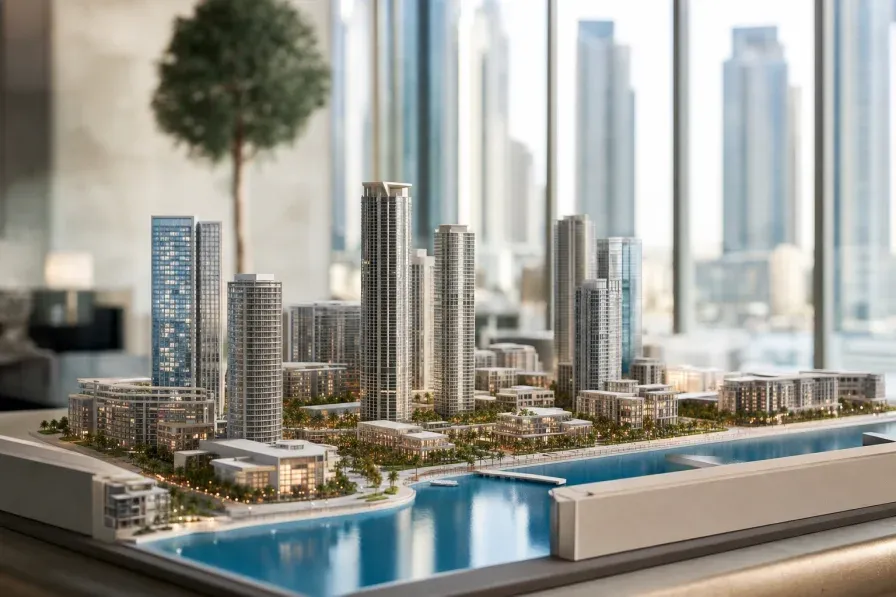
An off-plan property is a unit you purchase directly from a developer before construction is complete, sometimes before ground is broken. You sign a Sales and Purchase Agreement (SPA), pay a series of installments according to the developer’s payment plan, and receive the keys at handover, typically two to four years later. The transaction is registered with the Dubai Land Department through the Oqood system during construction, and converted to a full title deed at handover.
This isn’t a niche product in Dubai. According to DXB Interact / DLD transaction data, off-plan accounts for roughly 70.9% of all sales: 154,321 off-plan deals against 217,802 total transactions over the past year. When more than two thirds of a market trades a particular way, calling it “risky” misses the point. The right question is whether off-plan suits your specific situation.
The buyer experience differs from a ready-property purchase in three meaningful ways. First, your money goes into a regulated escrow account that the developer can only draw from when RERA verifies construction milestones; your funds are not sitting in the developer’s general account. Second, you’re paying in installments with no rental income coming back during construction, which means the construction period is a pure capital outlay. Third, you have the option to resell the contract before handover via assignment, which is how most short-term off-plan investors realise returns.
Buyer concerns cluster around three points: will the developer deliver on time, will the finished unit match the renderings, and what happens if something goes wrong. The honest answers are: most projects deliver, though delays of 6-18 months are common; finished quality varies more by developer than by price; and the escrow framework provides real but imperfect protection. We’ll work through each of these properly in the sections below.
Benefits of Buying Off-Plan Properties
Off-plan offers four concrete advantages over ready property: lower entry cost, payment flexibility, capital appreciation potential, and the ability to lock in a price at today’s level for a unit that won’t exist for years.
The entry cost advantage is the most often cited and the most often misunderstood. Off-plan units typically launch at prices below comparable ready stock in the same area, but this discount is conditional on you carrying the property through construction, paying installments without earning rent. The real benefit is leverage on appreciation. If you commit AED 720,000 across construction milestones on a AED 1.2M studio, and the area appreciates 10% to AED 1.32M before handover, your potential resale return through assignment is roughly 17% on the AED 720,000 actually deployed, not 10% on the headline price.
Payment flexibility is the second genuine advantage. Developer payment plans are interest-free; they are not mortgages. Common structures include 60/40 (60% during construction, 40% at handover), 50/50, and 20/80 plans where most of the cost is deferred to handover. Some developers offer post-handover plans that extend payments 1-7 years after you receive the keys, meaning you can rent the unit and use the income to fund remaining installments. This kind of structure simply does not exist in the ready market.
Off-plan generates zero rental income during construction. Every yield figure you see, including Dubai’s 7% citywide average, applies after handover, not during the years you’re paying installments.
The third benefit is locking in current prices. Dubai off-plan median price/sqft has risen 9% year-on-year per DLD transaction data; a buyer who locked in a 2024 launch price has already seen paper gains by 2026. The fourth benefit, customisation, is real but limited: most developers allow upgrades to flooring, kitchen finishes, and sometimes layout changes if requested early enough in construction. Premium developers like Sobha and Emaar typically offer wider customisation options than volume builders.
The location point matters more than most guides admit. A great unit in a thin rental market underperforms a mediocre unit in a high-demand area. Per Bayut’s 2025 market data, International City apartments yielded 10% post-handover, while premium areas like Downtown sat closer to 5-6%. The right location depends on your strategy: yield-focused investors look at Dubai Investment Park, JVC and Discovery Gardens; capital appreciation buyers look at Dubai Creek Harbour, Business Bay and emerging master-planned communities.
Risks and Challenges
The three real risks of off-plan are construction delays, design changes between renderings and reality, and developer financial distress, in roughly that order of probability.
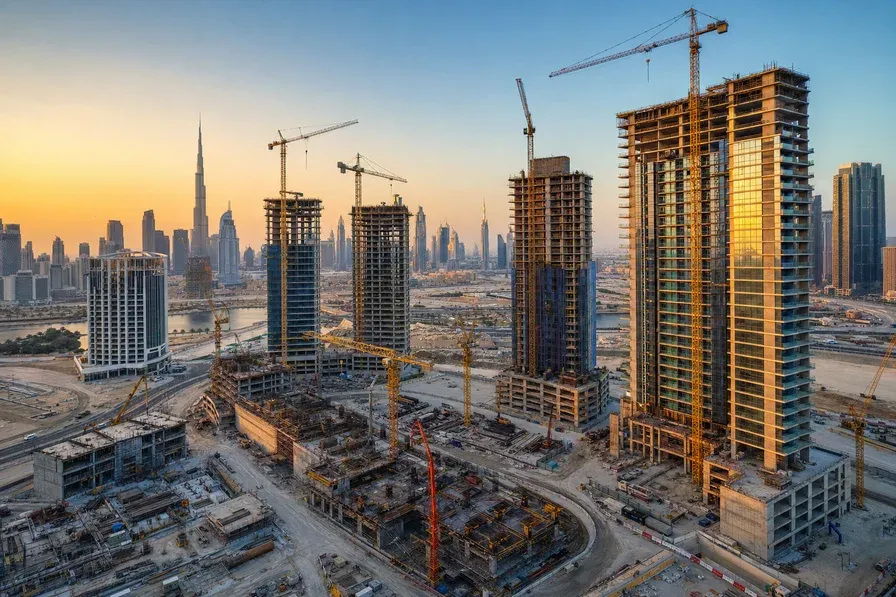
Construction delays are the most common issue. Knight Frank research suggests 30-35% of off-plan units complete behind schedule. Delays of 6-12 months are routine; delays of 12-24 months happen on a meaningful minority of projects. Your protection against delays sits in the SPA itself: a properly drafted SPA includes a penalty clause obligating the developer to compensate you (typically 1% per month of paid amounts, or rent allowance) if handover slips beyond a defined grace period. Many SPAs do not include this clause unless you specifically negotiate for it. Read every page of the SPA before signing, or pay a UAE property lawyer AED 2,500-5,000 to review it. This is the single best money you’ll spend in the entire process.
Design changes are the second risk. Renderings are marketing materials, not contractual specifications. The SPA will list specifications (flooring grade, kitchen brand, sanitaryware brand, ceiling height), but the renderings showing infinity pools facing the Burj Khalifa or floor-to-ceiling glass on every wall are not binding unless explicitly written into the SPA’s specifications schedule. Cross-reference renderings against the SPA specifications before signing, and ask the developer to put any verbal promises in writing.
Developer financial distress is the third and most consequential risk, but also the rarest. Dubai’s regulatory framework is built specifically to protect buyers from this scenario. Every off-plan project must have a RERA-approved escrow account; the developer can only withdraw funds against verified construction progress. If a developer fails, RERA can appoint a replacement developer, refund buyers from escrow, or auction the project to a new developer who completes construction. The 2009 crash forced the introduction of these protections; what happened then would not unfold the same way today.
How to protect yourself: check the project’s RERA permit number and escrow account on the DLD website before signing anything; pull the developer’s last five completed projects and check their original promised handover dates against actual delivery; verify the developer’s RERA classification rating; and never wire money to any account that is not the project’s named escrow account. If a sales agent suggests an alternative payment route, walk away.
Choosing the Right Developer
The developer matters more than the project. A great unit from a weak developer is still a weak investment; a standard unit from a proven developer is a far safer one. Here’s how to assess any developer in 30 minutes of research.
Start with delivery track record. Pull the developer’s last five completed projects from the DLD website and compare promised handover dates against actual handover dates. Emaar delivers approximately 85% of projects on time. Sobha sits at 82%, notable for a smaller developer matching the giants. Damac runs at 78%, reflecting their high simultaneous launch volume. If a developer’s track record shows more than two of five projects delayed by over 12 months, treat them as a red flag.
Second, check construction quality on completed projects. This requires physically visiting handed-over buildings from the same developer, ideally 2-5 years post-handover when defects emerge. Look at common areas, lift quality, paint condition, lobby finishes, and snagging that hasn’t been addressed. Talk to owners or tenants if you can; Reddit’s r/dubai and Facebook community groups for specific developments are surprisingly useful sources.
Third, verify the financial structure. Request the project’s RERA permit number, the escrow account number, and confirmation of the bank holding the escrow. All three should appear on the DLD project page. The developer should be willing to share this immediately. Hesitation is a warning sign.
Fourth, evaluate the developer’s pipeline. A developer running 30+ simultaneous projects has more scheduling pressure than one running 5-10. This isn’t disqualifying, but it changes the probability of delay. Match the developer’s scale to their delivery history.
Fifth, look at how the developer behaves during disputes. Search Dubai Courts records and the RERA dispute resolution committee for cases involving the developer. Every major developer has some disputes; what matters is the volume and the resolution. Frequent unresolved cases against the same developer suggest a pattern.
Major developers worth knowing for off-plan: Emaar (highest delivery reliability, premium pricing), Damac (high volume, aggressive launches, mixed delivery), Sobha (high construction quality, slower pace), Nakheel (master-planned communities, strong delivery), Azizi (mid-market focus, mixed track record), Binghatti (fast launches, distinctive design), Danube (popular 1% monthly plans, mid-market). Compare developers against your specific priorities (yield, capital appreciation, or end-use quality) rather than chasing brand prestige alone.
The Buying Process
The off-plan buying process in Dubai follows nine steps, from reservation to title deed. Most buyers complete the journey from booking to handover in 2-4 years.
Two procedural points are worth highlighting. First, the 4% DLD registration fee is paid once, at the start of the deal through the Oqood Initial Sale registration, not at handover. Oqood records your contractual claim during construction and converts to a title deed at handover with no additional 4% charge. Smaller title-deed issuance and admin fees can apply at completion, but the headline 4% is a single upfront cost, not a fee that is repeated at title-deed transfer.
Second, you can exit before handover via assignment. If the project appreciates and you want to sell, you transfer the SPA to a new buyer who takes over remaining payments. This is how short-term off-plan investors realise returns. Each major developer has its own assignment threshold: the percentage you must have paid before they’ll issue the No Objection Certificate that enables transfer. Damac requires 35% paid, Emaar 40%, Nakheel 45%. NOC fees range from AED 500 to AED 15,000, and some developers charge additional assignment fees of 0.5-5% of the resale value. The transfer itself completes at a DLD trustee office in 7-10 working days.
Snagging, the pre-handover inspection, is where many buyers leave value on the table. The standard practice is to walk the unit yourself, list every defect (paint marks, tile alignment, plumbing leaks, scratches), and require the developer to fix everything before you accept handover. Professional snagging services cost AED 500-2,000 and routinely identify 50-150 issues that a non-expert misses. For a property worth AED 1M+, this is trivial money.
Browse off-plan projects across Dubai on Projectory to see how these payment structures and handover timelines play out across different developers and areas.
After reserving, use our Dubai off-plan construction progress guide to follow the official DLD record, compare developer updates and keep each payment milestone documented.
Financing Options
Off-plan financing usually combines a developer payment plan during construction with bank finance later in the build or at handover. The bank has to approve both the buyer and the exact project, and each lender sets its own construction and buyer-payment thresholds.
Developer payment plans are interest-free installment arrangements directly between you and the developer. The most common structures are 60/40, 50/50, 30/70 and 20/80. Post-handover plans extend payments 1-7 years after you receive the keys. The 1% monthly plans popularised by Danube Properties spread the payment burden into rent-sized chunks but typically require a 10-20% down payment first. None of these structures charge interest, but missing a payment triggers penalties of 1-2% per month on the overdue amount, and extended default can result in contract termination with forfeiture of paid amounts.
The UAE Central Bank’s current rulebook lists a 50% maximum loan-to-value for property purchased off-plan. Banks can lend less and may restrict finance to approved developers or developments. Current public routes use different milestones: some start once construction reaches 30% or 35% and the buyer has paid 50%, while others keep renewing a pre-approval until the buyer reaches the required payment stage or handover. Mortgage registration costs 0.25% of the loan amount plus the applicable administration charge.
A crucial 2025 rule change: mortgage lenders can no longer roll the 4% DLD fee into the loan. You must pay DLD fees in cash at the start of the deal, alongside the booking and down payment, not from mortgage drawdown. Budget for this separately when planning your finances.
Pre-approval matters more for off-plan than for ready purchases because your financing position changes over the construction period. Get a pre-approval before signing the SPA, then refresh it 6-12 months before expected handover. Banks reassess your income, debt obligations and credit profile at the point of actual mortgage drawdown. A change in employment between booking and handover can derail the financing entirely. Our Dubai off-plan mortgage guide compares the current ADCB, Mashreq, CBD, Emirates NBD and ADIB routes and sets out the full cost checklist.

If your purchase is approaching completion, use our Dubai off-plan handover mortgage checklist to time pre-approval, valuation, final bank approval, mortgage registration and drawdown across the final 12 months.
Legal Considerations
The legal framework for Dubai off-plan is one of the most regulated in the world, but the protections only work if you actually use them. Here are the documents and rules that matter.
The Sales and Purchase Agreement (SPA) is the document that controls everything. Before signing, verify these specific clauses: handover date with a defined grace period, penalty clause for delays beyond grace period, exact unit specifications (not renderings), payment schedule with milestone definitions, your assignment rights (can you resell, and at what threshold), what happens if the developer fails, and dispute resolution mechanism. Have a UAE-qualified property lawyer review the SPA; expect to pay AED 2,500-5,000 for a thorough review. This is non-negotiable on any purchase above AED 1M.
DLD fees in off-plan transactions involve the buyer and the developer, not buyer and seller. The standard 4% transfer fee is often partially or fully waived by developers as launch incentives: full waivers (developer pays the entire 4%), partial waivers (50%, buyer pays 2%), and “DLD included in price” structures are all common. DLD waivers are non-transferable, meaning if you resell before handover, the waiver does not pass to the new buyer. Always confirm in writing what your specific developer is offering.
Off-plan property valued at AED 2 million or more qualifies for the 10-year Golden Visa via Oqood registration. Buyers do not need to wait for handover.
The Golden Visa point is widely misunderstood. The 10-year Golden Visa is available to buyers of off-plan property valued at AED 2M+ provided they have a registered Oqood certificate and proof of payment to the developer covering the AED 2M threshold. Some cases require the project to be 50%+ complete; if the property is mortgaged, the bank must provide a no-objection letter showing paid equity meets AED 2M. The 2-year investor visa has different rules and requires a completed property with title deed. Don’t confuse the two.
Tax position: Dubai has zero capital gains tax, zero annual property tax, and zero tax on rental income. Off-plan resale profits via assignment are tax-free in Dubai. Your home country may tax your worldwide income; UK, US, Indian, and most European tax residents need to consider home-country obligations regardless of Dubai’s position.
Dispute resolution runs through the RERA dispute resolution committee or Dubai Courts (real estate division). Both routes are accessible to international buyers. Document everything throughout the purchase: keep email chains, payment receipts, marketing materials, and signed addenda. In a dispute, the buyer with documentation wins.
Real-Life Patterns: How Off-Plan Plays Out
Rather than fabricated case studies, here are the patterns that actually emerge from Dubai’s off-plan market, covering what tends to work and what tends to go wrong.
The most common successful pattern is the medium-term yield investor. They buy a one-bedroom unit in a yield-focused area like JVC, Dubai Investment Park or Discovery Gardens at AED 800,000-1.2M, hold through handover, and rent the unit for 7-10% gross yield post-handover per Bayut 2025 data. The construction years are a pure cost: they hold capital, pay installments, and earn nothing. The math works because the post-handover yield, combined with capital appreciation, compounds over a 5-10 year hold. This pattern fails when the buyer underestimated service charges (AED 8-25 per sqft annually) or overestimated achievable rent.
The capital appreciation pattern targets premium master-planned communities like Dubai Creek Harbour, Business Bay or Downtown extensions. Buyers commit to 50-70% of the price across construction, hoping to either resell via assignment near handover at a premium or hold for long-term appreciation. This pattern delivers strongest returns when bought at launch; early-phase units in successful master plans have routinely appreciated 20-40% by handover. It fails when buyers chase the third or fourth phase of a project, where the easy appreciation has already happened.
The end-user pattern is different again. End-users, meaning people buying to live in the unit, should optimise for delivery reliability and finish quality, not yield. The right developer (Emaar, Sobha) and the right area (Dubai Hills Estate, Arabian Ranches, Dubai Creek Harbour) matter far more than payment plan structure. End-users who get this wrong typically end up with a unit that’s perfectly fine but in an area that doesn’t suit their actual lifestyle.
The pattern that consistently goes wrong: buyers who chase aggressive payment plans on speculative-area launches without checking the developer’s track record. The headline 1% monthly or 80% post-handover offer looks attractive, but if the developer has a poor delivery record or the area lacks the infrastructure to support tenant demand at handover, the buyer ends up holding a delayed asset in a soft rental market. Check the developer first, the area second, the payment plan third, and never the reverse.
The lessons that repeatedly emerge: read the SPA, verify the escrow, choose the developer before the project, run your numbers assuming handover is 18 months late and first-year rent is 20% below current market levels. If the investment still works under those conditions, proceed.
Service Charges Off-Plan Dubai: Costs, Estimates and Buyer Checks
Read our detailed analysis: Service Charges Off-Plan Dubai: Costs, Estimates and Buyer Checks
DLD Waivers in Dubai: How Developers Reduce Off-Plan Costs
Read our detailed analysis: DLD Waivers in Dubai: How Developers Reduce Off-Plan Costs
RERA and Escrow Protection for Dubai Off-Plan Buyers
Read our detailed analysis: RERA and Escrow Protection for Dubai Off-Plan Buyers
Frequently Asked Questions
What are the potential risks of buying an off-plan property in Dubai?
The three main risks are construction delays (affecting roughly 30-35% of projects per Knight Frank), design or specification differences between renderings and the delivered unit, and developer financial distress (rare but consequential). Dubai’s escrow framework provides genuine protection; your installments sit in a regulated account the developer can only access against verified milestones. See the Risks and Challenges section for how to protect yourself.
How can I ensure the developer is reputable when buying an off-plan property?
Pull the developer’s last five completed projects from the DLD website and compare promised handover dates against actual delivery; if more than two were delayed over 12 months, look elsewhere. Verify the project’s RERA permit and escrow account on the DLD website, and check the developer’s RERA classification rating. Visit completed projects from the same developer to inspect construction quality first-hand.
What is the typical payment schedule for off-plan property purchases in Dubai?
Common structures include 60/40, 50/50, 30/70 and 20/80 splits between construction and handover, plus post-handover plans that extend payments 1-7 years after you receive the keys. All developer payment plans are interest-free; they are direct installment arrangements, not mortgages. The specific structure varies by developer and project.
Can I customize my off-plan property in Dubai?
Yes, but customisation options vary significantly by developer and how early in construction you commit. Premium developers like Sobha and Emaar typically allow upgrades to flooring, kitchen finishes, sanitaryware, and sometimes minor layout changes. Volume builders offer fewer options. Always get customisation agreements in writing as an SPA addendum.
What legal documents should I review before purchasing an off-plan property?
The Sales and Purchase Agreement (SPA) is the critical document; it controls handover timing, penalties, specifications, payment schedule, and your resale rights. Also verify the RERA permit, the escrow account details, the developer’s company registration, and any DLD waiver or incentive in writing. Pay AED 2,500-5,000 for a UAE property lawyer to review the SPA. See the Legal Considerations section.
Are there any tax implications for buying an off-plan property in Dubai?
Dubai charges zero capital gains tax, zero annual property tax, and zero tax on rental income, including profits from off-plan resale via assignment. Your home country may tax worldwide income regardless of Dubai’s position, so UK, US, Indian and most European tax residents should check home-country obligations. The 4% DLD transfer fee is the main transaction cost, often partially or fully waived by developers.
How do I secure financing for an off-plan property in Dubai?
Most buyers use developer payment plans during construction (interest-free installments) and only consider a bank mortgage from 40%+ project completion onwards. Banks require 50%+ of the purchase price to be paid from your own funds before releasing mortgage funds, and loan-to-value ratios are 50-60% for off-plan. International buyers can access UAE mortgages but face higher down payment requirements and slightly higher rates.
Related budget guide: Off-Plan Property Under AED 1 Million in Dubai — what an AED 1 million budget realistically buys in Dubai off-plan, with named projects and payment-plan checks.
Closing Thought
The investors and end-users who succeed with Dubai off-plan are not the ones who found the cleverest project or the most aggressive payment plan. They are the ones who read the SPA, verified the developer, and ran their numbers against a worst-case scenario before signing. Everything else, the area, the floor plan, the launch incentive, is secondary to those three actions.
Explore off-plan projects across Dubai on Projectory to compare developers, payment structures and handover timelines side by side.
About the Projectory Team
Projectory’s editorial content is created and reviewed by its founders, who bring more than 30 years of combined experience brokering, buying, developing and selling property in the UAE.
In this guide series
- Buying GuidesDubai Off-Plan SPA: What Buyers Should Check
- Buying GuidesHow to Track Your Off-Plan Construction Progress in Dubai
- Buying GuidesDubai Off-Plan Handover Mortgage Checklist: Final 12 Months
- Buying GuidesRERA and Escrow Protection for Dubai Off-Plan Buyers
- Buying GuidesDLD Waivers in Dubai: How Developers Reduce Off-Plan Costs
- Buying GuidesService Charges on Off-Plan Property in Dubai: What to Check
- Buying GuidesUnderstanding DLD Fees for Off-Plan Property in Dubai