
Off-Plan Developer Bankruptcy Dubai: What Buyers Need to Know
Worried about off-plan developer bankruptcy Dubai risks? Learn escrow protections, cancellation rules, warning signs and safer project checks.
Off-plan developer bankruptcy in Dubai is one of the biggest fears for first-time buyers. The real risk, however, is not usually an instant total loss. It is delay, paperwork, uncertainty over whether to keep paying instalments, and contracts that were not stress-tested before signing.
Actual developer bankruptcy is now rare in Dubai. The regulatory framework introduced after 2009 has materially strengthened buyer protection. But the fear remains common, so this guide addresses what the framework actually does, where it has limits, and what buyers should still verify before paying any reservation amount.
This guide turns that fear into a practical workflow: what to verify before paying, how escrow and Oqood protect buyers, how payment plans change your exposure, and what to do if your developer shows signs of financial distress. The broader UAE off-plan investment guide shows where this risk sits alongside project selection, cash-flow planning and exit strategy.
Editorial note: This guide is part of Projectory’s commitment to transparent buyer education. We believe informed buyers make better property decisions, including the decision to buy. Dubai’s regulatory framework for off-plan property is one of the strongest in the region, but understanding how that framework works, and what it does not cover, helps buyers reserve with confidence.
What’s in this guide:
Quick answer:
- Will I lose everything if my developer goes bankrupt? Not automatically. Buyer payments made into the approved project escrow account are ring-fenced for that specific project, separate from the developer’s general business funds.
- The bigger real risk: Construction delays, administrative uncertainty, and difficult decisions about whether to continue paying under the SPA while the project status is clarified.
- Most important check before paying: Verify the DLD/RERA project registration and confirm that payment instructions point to the approved project escrow account, not a developer corporate account.
- Payment-plan exposure matters: A 20/50/30 plan commits 70% before handover; a 20/20/60 plan keeps 60% with the buyer until completion. Same purchase price, very different distress exposure.
- Walk away if: Payment instructions go anywhere other than the named project escrow account, the developer will not provide registration details, or you are asked to sign before receiving the full SPA.
Data note: This guide refers to Dubai Land Department services and public market reporting available at the time of writing, including Cavendish Maxwell Q1 2026 market commentary reported by Gulf News. Real estate data, project registration status, escrow details, payment plans and construction progress can change quickly. Verify project-specific information directly before committing. This guide is for buyer education and does not replace legal advice on a specific SPA.
Key takeaways:
- Escrow does not guarantee that a project will finish on time. It ring-fences buyer payments for the registered project and controls how funds are released.
- Developer bankruptcy, project delay, buyer default and project cancellation are different scenarios with different remedies.
- The SPA matters as much as the brochure. Default clauses, force majeure wording, assignment rules and payment obligations decide what you can actually do.
- Payment-plan structure materially changes exposure: the more you pay before handover, the more capital sits inside the project pipeline if distress appears.
- The safest workflow is project first, developer second: verify registration, escrow, Oqood/initial sale registration, construction status and the SPA before relying on brand reputation.
For the full Dubai off-plan buying process from reservation through SPA review, payment plans and handover, read the complete guide to off-plan property in Dubai. For broader risk verification including escrow checks and developer assessment, see is off-plan property safe in Dubai?.
What developer bankruptcy means for a Dubai off-plan buyer
Developer bankruptcy in Dubai does not usually mean an immediate total loss for off-plan buyers. More often, it means construction slows or stops, the project status is reviewed, and buyers wait for clarity on whether the project will continue, be restructured, transfer to another developer, or be cancelled through official channels.
Buyers often mix up four separate scenarios:
The distinction matters because each scenario has a different remedy. A delay is handled through written updates, SPA review and monitoring. A cancellation follows an official process. Developer insolvency sits in a more complex lane because the financial health of the developer and the legal status of the individual project are not always the same thing.
A developer can be under financial pressure while one project remains viable. A project can also struggle even when the developer is still operating. That is why buyers should avoid broad assumptions and verify the specific project, escrow account and SPA position.
The Dubai safety net: escrow, RERA registration and Oqood
Dubai’s off-plan regulatory framework was substantially strengthened after the 2008-09 property correction. The protections in place today are the result of that reform process, and they rest on three practical checks:
- The project should be registered with the relevant Dubai authorities.
- Buyer payments should flow into an approved project escrow account.
- The buyer’s interest should be registered through the applicable initial sale/Oqood process.
Escrow is the most important concept to understand. When you pay an instalment on a properly registered off-plan project, the payment should go into a dedicated project escrow account, not the developer’s general operating account. The purpose is to keep buyer funds tied to the project and control releases against construction progress and regulatory requirements. Our guide to RERA and escrow protection for Dubai off-plan buyers covers the trustee controls, DLD checks and formal cancellation route in detail.
This does not mean escrow guarantees a refund or a completed home. It means the money is not supposed to be treated like the developer’s general cash. The buyer’s exposure at any point depends on:
- how much has been paid;
- how much has been legitimately released for construction;
- the stage of construction;
- the project’s official status;
- the remedies available under the SPA.
That is why the question is not simply, “Is there escrow?” The better question is: “Is this project registered, is the escrow account correct, has my initial sale been recorded, and what does my SPA say if the project stalls?”
Before paying a booking fee, ask for:
- The DLD/RERA project registration details, then verify the project through official channels where available.
- The project escrow account details: bank name, account number and account name. The account name should clearly reference the project.
- Written confirmation of the initial sale/Oqood registration process, timing and charges.
- The full SPA, not only a reservation form or payment schedule.
- Assignment, NOC, default, cancellation and force majeure clauses in writing.
- A clear payment schedule showing which instalments are tied to dates and which are tied to construction milestones.
This discipline matters most in fast markets. Cavendish Maxwell’s Q1 2026 Dubai residential market commentary, reported by Gulf News, recorded approximately 44,200 residential transactions in the quarter, with off-plan transaction volume up 10.5% year-on-year. High transaction velocity can create pressure to reserve quickly. It should not shorten the verification process.

What can happen after a developer gets into financial trouble
When a Dubai off-plan developer enters financial distress, the project does not automatically collapse. One of several outcomes may follow.
The pathway depends on factors buyers cannot fully control: construction progress, escrow balance, land status, project viability, the developer’s broader obligations and regulatory decisions. A substantially advanced project with documented construction progress is in a different position from an early-stage project with limited physical progress.
The part buyers should prepare for is time. Even when the eventual outcome is positive, distress can mean months of notices, document requests and unclear communication. During that period, buyers face a serious decision: continue paying instalments as scheduled, or pause payments and risk being treated as in default if the project remains legally active.
The wrong move is to stop paying based on rumour. The better move is to:
- verify the official project status;
- request a written update from the developer;
- review the SPA’s default and force majeure clauses;
- collect all payment and registration evidence;
- get qualified legal advice before withholding payments or cancelling.
How payment plans change your bankruptcy exposure
Payment-plan structure is one of the most controllable parts of bankruptcy exposure. The more money you commit before handover, the more capital sits inside the project pipeline if something goes wrong. The more you defer to handover, the more cash and leverage you retain, although you may face a larger financing requirement at completion.
A simple AED 1.5M example shows the difference. These are illustrative payment plans; actual structures vary widely by developer and project.
The difference between a 20/50/30 plan and a 20/20/60 plan on the same AED 1.5M purchase is AED 450,000 of pre-handover cash exposure.
This does not mean back-loaded plans are always better. Front-loaded plans may come with lower pricing, stronger allocation choices or other commercial terms. Back-loaded plans may create stress if mortgage approval, liquidity or resale assumptions do not work at handover. The point is that payment plans are not just affordability tools. They are risk-allocation tools.
Before trusting a payment plan, check:
- Total pre-handover cash required: down payment plus construction-stage instalments.
- Whether payments are date-based, construction-linked or a mix of both.
- Handover lump sum and how you will fund it if mortgage terms change.
- Whether any post-handover payments apply and what happens if you miss one.
- Late-payment penalties, cure periods and termination clauses.
- Whether assignment is allowed before handover, and at what payment threshold.
- Whether developer NOC fees, assignment fees or restrictions affect your exit route.
Payment-plan structure should never be used as a standalone safety measure. Pair it with registration checks, escrow verification, construction progress, developer delivery history and SPA review.
Browse current Dubai off-plan projects by area, developer, starting price, payment plan and handover date on Projectory.
Warning signs to check before buying any off-plan project
The strongest warning signs usually appear before you sign. A developer’s behaviour during due diligence often tells you more than its sales presentation.
Project-level due-diligence checklist:
- DLD/RERA project registration details are provided and can be checked.
- Escrow account details are project-specific and match the payment instructions exactly.
- The developer provides the full SPA before asking for substantial payment.
- Initial sale/Oqood registration process and charges are explained in writing.
- Construction updates are dated, specific and consistent.
- Land status and project approvals are clear enough for your lawyer to review.
- Previous project handovers can be checked against originally promised timelines.
- Assignment, cancellation and default clauses are clear before signing.
Behavioural red flags are often more revealing than the brochure:
- Pressure to pay outside escrow. Any request to wire money to a developer corporate account, third-party facilitator, offshore account or personal account is a hard stop.
- Refusal to provide registration details. A properly registered project should not make buyers chase basic verification documents.
- Only sharing marketing material. A payment schedule is not a contract. You need the SPA and its full risk clauses.
- Vague construction milestones. Wording such as “subject to market conditions” or payment triggers entirely at the developer’s discretion can shift risk onto the buyer.
- Unusually aggressive late-stage discounts. A discount is not automatically a red flag, but very large reductions on a slow-moving or half-sold project deserve deeper cash-flow questions.
- Repeated unexplained timeline changes. One delay can be manageable. Multiple unexplained changes in a short period require written clarification.
Developers with long delivery histories give buyers more public track record to examine. Projectory’s developer catalogue includes detailed profiles for the main UAE developers, each with their own delivery history, project pipeline and active inventory. But brand recognition is not a substitute for project verification. A buyer is usually safer with a properly registered, escrow-clean project from a smaller developer than with an unclear launch from a familiar name.
The order should be: verify the project, then verify the developer.
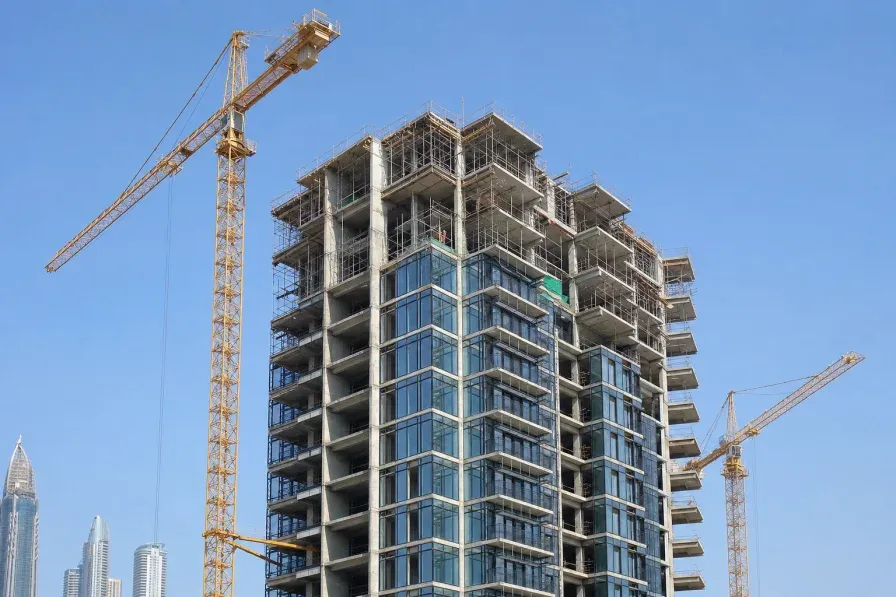
What to do if your Dubai off-plan developer is in distress
If you suspect your Dubai off-plan developer is in financial trouble, do not stop paying instalments based on rumour. Collect documents, verify the official project status, request written updates, and get legal advice before changing your payment behaviour.
Follow this workflow:
- Collect every document. Keep the SPA, reservation form, payment receipts, escrow transfer confirmations, Oqood or initial sale registration evidence, payment schedule, developer notices, construction updates and broker correspondence in one dated folder.
- Verify the project status. Use official Dubai Land Department channels where available to check project status and registration. Do not rely only on broker updates or buyer WhatsApp groups.
- Request a formal written update. Email the developer and ask specifically about construction progress, revised handover timing, escrow/payment status and any restructuring affecting the project.
- Read the SPA default clauses. Identify what happens if you miss an instalment, what rights you have if the developer delays, and what dispute-resolution process applies.
- Check whether your payments are fully documented. You should be able to match each payment to an official receipt or bank transfer confirmation.
- Avoid panic resale. Do not assign the unit at a steep discount until you understand whether the distress is verified, temporary or project-specific.
- Get qualified legal advice. This is essential before withholding instalments, terminating, filing a claim or entering a settlement.
The principle is simple: document everything in writing, verify before reacting, and do not put yourself in breach unless a lawyer has reviewed your specific SPA and project status.
Frequently asked questions
If an off-plan developer goes bankrupt in Dubai, do buyers automatically lose their money?
No. Payments made into the approved project escrow account are ring-fenced for that project and are not intended to be available to the developer’s general creditors. The actual outcome depends on construction progress, escrow releases, project viability and official decisions about whether the project continues, transfers, restructures or is cancelled.
Can I stop paying my instalments if I hear my developer is in financial trouble?
Not based on rumour. If you stop paying without a contractual basis, you may be treated as in default under the SPA. First verify the official project status, request a written update from the developer, review your SPA and get legal advice on your specific contract.
How does a Dubai escrow account protect buyers when an off-plan project is delayed or distressed?
A project escrow account keeps buyer payments separate from the developer’s general business funds and controls how money is released for the registered project. It reduces misuse risk, but it does not guarantee on-time completion or a full refund in every scenario.
What documents should I check before buying from a smaller or newer Dubai developer?
Check project registration details, escrow account information, initial sale/Oqood registration process, the full SPA, construction status, land/project approval evidence and the developer’s previous delivery record. For a newer developer, the project documents matter even more because there is less delivery history to rely on.
Is a 60% payment on handover plan safer if I am worried about developer bankruptcy?
It reduces pre-handover cash exposure. A 20/20/60 plan keeps 60% of the purchase price with the buyer until completion, while a 20/50/30 plan commits 70% before handover. But it also creates a larger handover funding requirement, so you need to stress-test mortgage approval, liquidity and exit options.
What is the difference between developer bankruptcy, project cancellation and construction delay?
A construction delay means the project is late but still active. Project cancellation is a formal outcome where the project is wound down through official channels. Developer bankruptcy is financial distress of the developer entity, which may or may not affect the specific project depending on registration, escrow, construction progress and official decisions.
Should overseas buyers handle bankruptcy risk differently from UAE residents?
The legal framework is broadly the same, but practical access is harder from abroad. Overseas buyers should insist on receiving registration details, escrow information, the full SPA and initial sale/Oqood registration evidence before paying. They should also consider UAE-based legal review rather than relying only on broker or sales-team assurances.
Sources and useful references
- Cavendish Maxwell. Dubai Residential Market Performance Q1 2026 reporting via Gulf News
- Dubai Land Department. Project Status Enquiry
- Dubai Land Department. Request to Register the Initial Sale
- Dubai Land Department. Property Sale Registration
Final verdict: bankruptcy fear is loudest before purchase and quietest after handover
Bankruptcy fear is loudest before purchase and quietest after handover. The workflow before you pay matters more than reassurance after you sign. Buyers who verify project registration, escrow, the SPA and payment-plan exposure typically find that the regulatory framework does what it’s designed to do: protect buyer interests through the construction period and into completion.
Verify registration, confirm escrow, read the SPA in full, and stress-test the payment plan against delay, distress and exit risk. The framework works when buyers do their part.
Browse current Dubai off-plan projects by area, developer, starting price, payment plan and handover date on Projectory, then review the project card and official documents before shortlisting.
Also read: Capital appreciation off-plan Dubai
Also read: Golden Visa Dubai Through Property: 2026 Guide
Also read: How to Build an Off-Plan Property Portfolio in the UAE
Also read: Off-Plan Property Tax Benefits: Why the UAE Draws Investors
Also read: Common Off-Plan Mistakes in Dubai and How to Avoid Them
Also read: Dubai Off-Plan Mortgage: Which Banks Lend and What It Costs
About the Projectory Team
Projectory’s editorial content is created and reviewed by its founders, who bring more than 30 years of combined experience brokering, buying, developing and selling property in the UAE.
In this guide series
- Buying GuidesDubai Off-Plan Mortgage: Which Banks Lend and What It Costs
- Investment & ReturnsHow to Sell Dubai Off-Plan Property Before Handover: Assignment Sales Explained
- Buying GuidesCommon Off-Plan Mistakes in Dubai and How to Avoid Them
- Investment & ReturnsOff-Plan Property Tax Benefits: Why the UAE Draws Investors
- Investment & ReturnsHow to Build an Off-Plan Property Portfolio in the UAE
- Buying GuidesGolden Visa Property Documents in Dubai: Oqood, SPA & Evidence Explained
- Buying GuidesGolden Visa Dubai Through Property: 2026 Guide
- Investment & ReturnsCapital Appreciation in Dubai Off-Plan Property
- Investment & ReturnsROI on Off-Plan Property in Dubai: Current Projects, Prices & Track Record
- Buying GuidesIs Off-Plan Property Safe in Dubai? Buyer Safety Guide