Off-Plan Property Investment in the UAE: Explained
Assess UAE off-plan property investment by emirate, buyer profile, ROI inputs, exit route and risk before shortlisting projects.
The opening question for any UAE off-plan investor is not which project to buy. It is whether off-plan ownership fits the investor’s holding period, construction-period cash flow, handover funding plan and realistic exit route.
A buyer who treats off-plan property as one product across all seven emirates is already mispricing risk. Dubai, Abu Dhabi, Sharjah, Ras Al Khaimah, Ajman and Umm Al Quwain have different authorities, demand depth, payment-plan norms, tenant pools and resale liquidity. The investment case has to be built emirate by emirate, then project by project.
This guide is a parent framework for that decision. It explains who UAE off-plan investment suits, how the emirate changes the risk-return profile, which ROI inputs to model before shortlisting, how payment plans can create handover pressure, and how to define the exit route before paying a booking amount.
Quick answer:
- Best fit: investors with a 3-5 year horizon, construction-period liquidity and a funded handover plan.
- Best for capital growth: buyers who can wait through construction and accept that gains are unrealised until resale or handover.
- Best for rental income: buyers who can reach handover, lease the unit and model net yield after service charges, vacancy and operating costs.
- Highest data depth: Dubai, where DLD, RERA, Oqood, escrow and resale data are more established than in smaller emirates.
- Reconsider if: the investment only works if the unit is resold before handover, or if affordability is judged mainly on the booking deposit.
Data note: This guide is for buyer education and does not replace legal, tax or investment advice on a specific purchase. Market figures are based on the latest public source pack available at the time of writing, including DLD and DXB Interact transaction data, Cavendish Maxwell, Knight Frank and ADREC. Live project and developer counts are correct at the time of writing and should be refreshed before future updates.
Key takeaways:
- Off-plan earns zero rent during construction. Any build-period return is unrealised capital appreciation or a possible assignment, not rental income.
- Gross yield, net yield and total ROI are different numbers. Service charges, vacancy, management, maintenance, financing and exit costs can materially change the result.
- Dubai’s off-plan market has the strongest transaction depth in the UAE, but its DLD, RERA, Oqood and 4% DLD fee framework should not be assumed in other emirates.
- Abu Dhabi, Sharjah, Ras Al Khaimah, Ajman and Umm Al Quwain can work for specific investment theses, but each needs authority-level verification and separate liquidity assumptions.
- The largest under-modelled risk is often the handover payment, not the booking deposit.
For the full Dubai buying process, from reservation through SPA review, payment plans and handover, read the complete guide to off-plan property in Dubai. For Dubai-specific investment modelling, use the Dubai off-plan ROI guide.
Is UAE off-plan investment right for your time horizon?
UAE off-plan investment works when the buyer can fund the journey from booking to handover without needing a forced exit. The suitability test is less about optimism and more about cash-flow resilience.
| Suitability test | What to confirm before shortlisting |
|---|---|
| Holding period | Can you hold for at least the construction period, and ideally beyond handover if the resale market is weaker than expected? |
| Construction-period liquidity | Can you meet instalments without relying on resale before completion? |
| Handover funding | Can you fund the final payment through cash, approved finance or a realistic mix of both? |
| Income expectation | Are you comfortable earning no rent until the property is handed over and leased? |
| Exit fallback | If assignment is unavailable, can you complete, lease and hold? |
The key distinction is timing. A ready property can produce rent shortly after transfer. An off-plan property cannot. During construction, the investor is paying instalments into an asset that is not yet income-producing. The return is a paper gain unless the unit is assigned or later sold.
That does not make off-plan unsuitable. It means the investor needs a thesis that matches the product. Capital-growth-led buyers with patient capital may accept construction risk in return for earlier pricing, staged payments and exposure to future area maturity. Income-led buyers need to model the period with no rent, then the lease-up period after handover, before comparing off-plan with ready property.
If the investment only works because the buyer expects to resell before handover, the risk is high. Assignment depends on developer rules, minimum payment thresholds, market timing and buyer demand at the point of exit. It should be treated as an option, not as the base case.
How the emirate changes the investment case
The UAE off-plan market is not one market. The authority, buyer pool and liquidity profile change by emirate.
| Emirate | Investment profile | Main caution |
|---|---|---|
| Dubai | Deepest off-plan transaction data, broad international buyer pool, established DLD/RERA/Oqood/escrow framework and more active assignment market. | Do not assume every area or handover year has equal resale liquidity. |
| Abu Dhabi | Deeper activity than in previous cycles, supported by ADREC regulation, masterplan growth and government-led demand drivers. | Assignment mechanics, buyer pool and liquidity differ from Dubai. Verify with ADREC and the SPA. |
| Sharjah | Often more price-sensitive, family-led and end-user-oriented, with regulation through the Sharjah Real Estate Registration Department. | Dubai yield and resale assumptions should not be imported directly. |
| Ras Al Khaimah | Tourism and waterfront-led investment thesis, especially around Al Marjan Island and hospitality-linked demand. | Holiday-rental demand is more cyclical than standard residential leasing. |
| Ajman and Umm Al Quwain | Smaller markets with selective masterplan-led opportunities and lower entry prices. | Transaction depth and resale liquidity are thinner, so evidence matters more. |
| Fujairah | Potentially relevant for niche buyers, but public off-plan investment data is limited in the available source pack. | Treat unsupported yield or capital-growth claims sceptically. |
Dubai remains the reference market because it has the deepest evidence base. Cavendish Maxwell reported that off-plan accounted for 72.9% of Dubai’s residential sales activity in FY 2025, up from 69.3% in 2024. That supports the view that Dubai off-plan has meaningful transaction depth. It does not prove that every Dubai project is liquid, and it does not transfer to other emirates.
Abu Dhabi is no longer a minor footnote. ADREC reported AED 66 billion in real estate transaction value in Q1 2026, up 160.7% year on year. That points to materially deeper market activity, but the investment framework is still Abu Dhabi-specific. The buyer should verify the registered project, escrow or payment-protection route, SPA registration process and assignment rules through Abu Dhabi’s authority framework, not through Dubai terminology.
For other emirates, the responsible approach is conservative. Sharjah, Ras Al Khaimah, Ajman and Umm Al Quwain can offer lower entry prices or differentiated demand drivers, but smaller markets usually require stronger evidence before assuming easy resale.
The ROI inputs to model before comparing projects
ROI on off-plan property is not one number. It is a sequence of cash flows and exit assumptions.
At minimum, model these inputs:
- Purchase price and price per square foot: compare against recent area transactions, not only against developer launch pricing.
- Payment schedule: identify how much is due during construction, at handover and after handover.
- Registration and transfer costs: in Dubai, the 4% DLD transfer fee is a core cash-cost item. Other emirates use different authority frameworks.
- Oqood or interim registration: in Dubai, off-plan registration is part of the title process and should not be confused with a second transfer fee at handover.
- Service charges: these begin after handover and reduce net yield.
- Vacancy and lease-up: first-year rent may be lower if the unit takes time to lease.
- Management, maintenance and furnishing: these are real deductions from income, especially for overseas investors or furnished rentals.
- Mortgage cost: financing may change the return materially and may not be available on the same terms at handover as assumed at booking.
- Exit costs: developer NOC fees, agency fees, transfer costs and any assignment conditions should be modelled before purchase.
Illustration: why gross yield is only the starting point
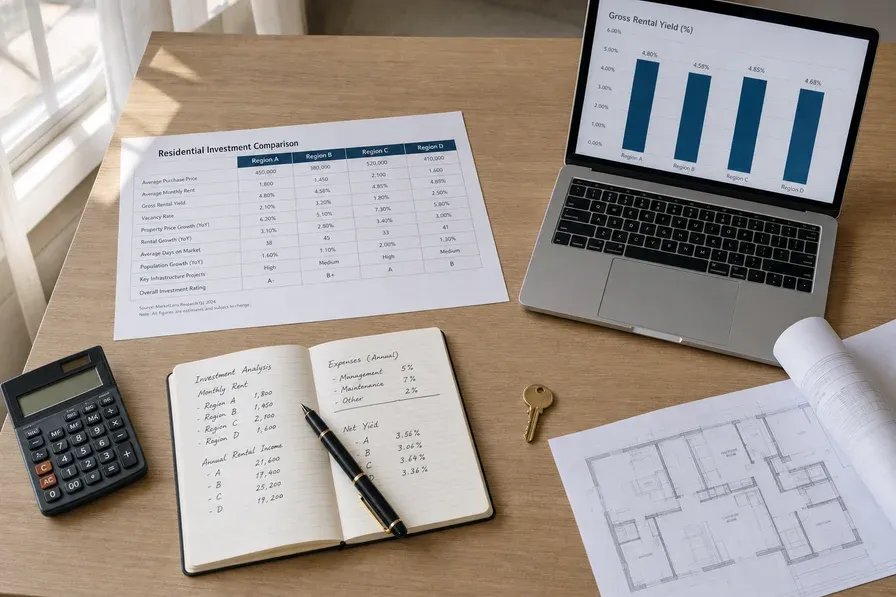
Assume an investor buys a Dubai off-plan apartment for AED 1,500,000 and expects AED 105,000 annual rent after handover. That is a 7% gross yield assumption.
| Item | Illustration |
|---|---|
| Purchase price | AED 1,500,000 |
| Assumed annual rent after handover | AED 105,000 |
| Gross yield before costs | 7.0% |
| Dubai DLD fee at 4% | AED 60,000 |
| Other deductions to model | Service charges, vacancy, management, maintenance, furnishing, insurance, mortgage cost if financed and resale costs |
The gross yield is not the investor’s return. If service charges, vacancy, management and maintenance reduce the annual cash income, the net yield is lower. If the buyer also paid DLD fees and other acquisition costs upfront, the total capital deployed is higher than the purchase price. If the project is delayed, the investor has more time with no rent.
The ROI question is therefore not: can the rent reach 7% of the purchase price? The better question is: does the investment still work after fees, service charges, vacancy, financing, delays and exit costs?
For a full Dubai-specific model, including pre-handover assignment versus post-handover rental economics, use the Dubai off-plan ROI guide. For Dubai fee mechanics, use the DLD fees guide.
Payment-plan structures and handover risk
A low booking deposit does not make an off-plan investment cheap. It only changes when the buyer pays.
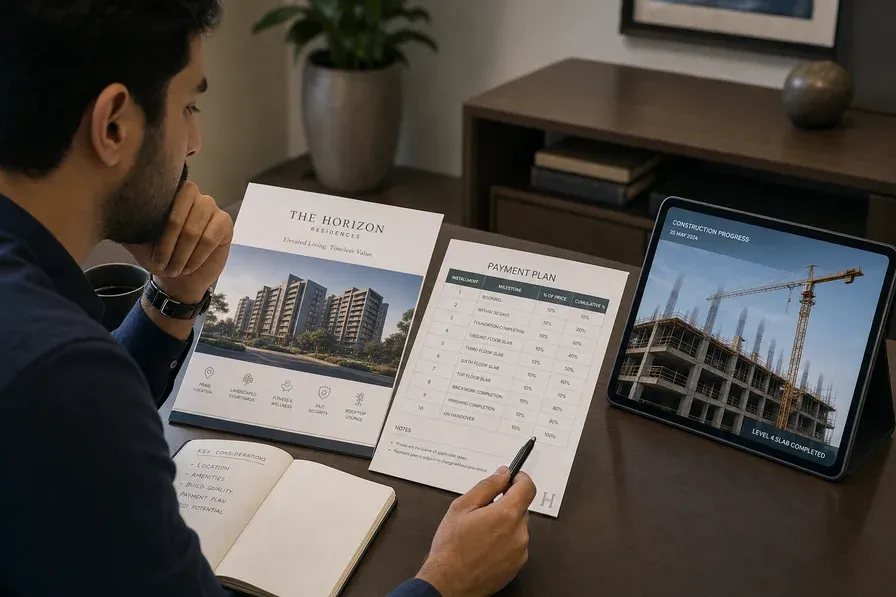
A 10/90 plan can look attractive because the construction-stage cash outlay is low. The risk is that 90% of the price is still due at handover. If finance is unavailable, the valuation is lower than expected or the resale market is weak, the buyer’s problem appears all at once.
A 50/50 plan creates more construction-period cash pressure but lowers the final lump sum. A post-handover plan may allow rent to offset part of the developer instalments, but the buyer still needs to understand title, default and transfer conditions in the SPA.
Run three stress tests before treating a payment plan as investable:
| Stress test | What it reveals |
|---|---|
| 12-month handover delay | Can you carry instalments and opportunity cost for longer with no rental income? |
| 15% softer rent | Does the net yield still work if rent is below the optimistic assumption? |
| No pre-handover resale premium | Can you still complete and hold if assignment produces no profit or is unavailable? |
Also check the SPA for missed-payment consequences. Do not rely on generic assumptions about grace periods, penalties or termination rights. The only version that matters is the signed contract and the applicable authority framework.
Area, developer and authority checks
Area selection should be criteria-led, not ranking-led. A top-ten list is only useful if the ranking criteria match the investor’s thesis.
Use this lens:
- Demand source: employment, schools, lifestyle, tourism, infrastructure or affordability.
- Tenant pool: families, professionals, corporate tenants, short-stay guests or end users.
- Infrastructure maturity: whether roads, metro access, schools, retail and healthcare are already in place or still planned.
- Future supply: whether the same submarket will receive large competing handovers in the same period.
- Service-charge risk: whether the amenity level will compress net yield.
- Resale depth: whether completed and off-plan units already trade in the area.
Live catalogue depth can help identify where there is more choice, but it is not a measure of investment quality. At the time of writing, the largest live Dubai area counts in the project catalogue include Dubailand with 37 projects, Town Square with 26, Dubai South with 22, Jumeirah Village Circle with 22, Dubai Hills Estate with 19, Dubai Investment Park with 19, Business Bay with 18 and Dubai Islands with 17.
The same applies to developers. The largest live developer counts include EMAAR with 92 projects, Binghatti with 43, Sobha Realty with 33, Aldar Properties with 29, DAMAC Properties with 27 and Ellington Properties with 24. This helps investors find comparable options, but developer count is not the same as delivery quality.
Before paying a booking amount, verify:
- the developer’s legal name and track record;
- the project registration or permit with the relevant authority;
- the escrow or payment-protection route;
- the SPA price, payment schedule, completion language and default clauses;
- handover, snagging and warranty terms;
- whether assignment is allowed and under what conditions.
In Dubai, this means checking DLD/RERA registration, project status and the escrow framework. The Dubai off-plan safety guide explains the buyer-protection checks in more detail. In other emirates, use the relevant authority rather than assuming Dubai’s terminology applies.
A project that cannot be verified through the appropriate authority is not investable at any ROI assumption.
Exit routes before and after handover
Every off-plan investment should have an exit route before the booking amount is paid.
There are three main paths.
Pre-handover assignment. The buyer transfers the SPA to another buyer before completion. This can work in Dubai when the developer permits assignment, the buyer has met the required payment threshold and there is demand for the contract. It is not automatic, and it is less certain in thinner markets.
Sale at or shortly after handover. The investor completes, receives title and sells as a completed unit. This avoids assignment rules but exposes the buyer to handover-window supply, market conditions and transaction costs.
Hold after rental stabilisation. The investor completes, leases the unit, absorbs the first lease-up period and sells later with rental evidence. This route needs more capital but is usually more resilient than relying on a quick assignment.
Legal permission to resell is not the same as liquidity. A market can allow assignment while still having too few buyers at the price the investor needs. This is why the exit route must be tested against area demand, developer rules, payment-plan progress and the handover year.
Decision tree: shortlist, wait or choose ready property
Shortlist off-plan if you have a multi-year horizon, construction-period liquidity, a funded handover plan, verified authority registration, a realistic post-handover rental model and an exit route that does not depend entirely on a quick resale.
Wait if the project documentation is incomplete, the price per square foot is not supported by local evidence, the handover payment is too large for your balance sheet, or the authority and escrow checks are unclear.
Choose ready property instead if rental income from day one matters, finance certainty is required now, personal occupancy is needed within the next year, or construction-period risk is not acceptable.
UAE off-plan property investment works as a framework, not as a product. The investor who has tested suitability, matched the thesis to the right emirate, modelled net ROI rather than headline yield, stress-tested handover and verified the project through the correct authority is ready to compare opportunities. The investor who skips those steps is comparing marketing material, not investment cases.
Frequently asked questions
Is UAE off-plan property better for capital growth or rental income?
It is usually a capital-growth route during construction and a rental-income route after handover. During construction, the property generates no rent. Any return is unrealised capital appreciation or a potential assignment gain. Rental income only begins after handover and lease-up.
Can I use Dubai ROI assumptions for Abu Dhabi, Sharjah or Ras Al Khaimah?
No. Dubai has its own DLD, RERA, Oqood, escrow and transfer-fee framework. Abu Dhabi, Sharjah, Ras Al Khaimah, Ajman and Umm Al Quwain use different authorities and have different transaction depth, tenant pools and resale liquidity. Rebuild the assumptions for the relevant emirate.
What is the main payment-plan risk?
The handover payment. A low construction-stage payment can leave the buyer needing to fund most of the purchase price at completion. Stress-test what happens if finance is unavailable, valuation is lower than expected, resale is slow or rent is softer than planned.
Should overseas investors start with Dubai before other emirates?
Dubai gives first-time UAE investors more data depth, a larger international buyer pool and a more familiar resale framework. Other emirates can be appropriate for diversification or specific demand theses, but they usually require more direct authority-level verification.
Is resale before handover realistic?
It can be realistic in Dubai when the developer permits assignment, the buyer has met the required payment threshold and there is buyer demand at the time of exit. It should not be treated as guaranteed. In smaller markets, legal permission may exist but liquidity can still be limited.
What should I verify before paying a booking amount?
Verify the developer, project registration, escrow or payment-protection route, SPA terms, payment triggers, handover language, snagging process, warranty terms and assignment conditions. Use the relevant emirate authority, not assumptions from another market.
Also read: Off-Plan Property Under AED 1 Million in Dubai — a budget-specific look at what under AED 1 million buys in Dubai off-plan.
Sources used
- Cavendish Maxwell. Dubai Residential Market Performance FY 2025
- ADREC. Q1 2026 press release on Abu Dhabi real estate transactions
- Dubai Land Department. Project Status Enquiry
- Dubai Land Department. Property Sale Registration
- DXB Interact. Dubai transaction data
- Knight Frank UAE. Dubai Residential Market Review
- Projectory live project and developer catalogue data, May 2026
Browse current UAE off-plan projects on Projectory to test this framework by area, developer, starting price, payment plan and handover date →