How to Build an Off-Plan Property Portfolio in the UAE
How to build an off-plan property portfolio in the UAE: spread risk across developers, areas and handovers, ladder payment plans and stage your exits.
An off-plan portfolio is a schedule, not a pile of units: a deliberate spread of risk and a sequence of payments and exits that you can fund whether or not every project hands over on time. If you run into trouble, it usually traces to structure rather than to the projects you picked: every payment plan peaked in the same quarter, every unit sat with one developer, and nothing produced cash until all of it completed at once.
This guide sets out how to build an off-plan property portfolio in the UAE as a managed cash-flow and risk plan rather than a buying spree. It is part of our complete guide to off-plan property investment in the UAE, and it assumes you already understand how a single off-plan purchase works. If you do not, start with the complete guide to off-plan property in Dubai first.
What’s in this guide:
- What does an off-plan portfolio actually mean?
- How many projects make a portfolio, and when do you start?
- How do you spread risk across developers, areas and handovers?
- How do you sequence payment plans and cash flow?
- What are the exit routes, and how do they interact?
- What costs and checks apply across the portfolio?
- Frequently asked questions
Key takeaways:
- A portfolio is structured diversification: spread developer, area, handover timing and home type so no single failure point sinks the whole position.
- The real limit is cash flow, not the size of your deposit. Off-plan property earns no rent during construction, so money only goes out, with nothing coming back, until units hand over and get rented out.
- Ladder handover dates so the heavy completion balances and the 4% registration fees do not all fall in the same quarter.
- Keep gross and net separate, and never stack capital appreciation, pre-handover assignment and rental income into one combined return.
- Stress-test the plan against a delayed handover, softer rent and a market with few buyers when you come to resell before you commit to the second or third unit.
Data note: The project prices, payment plans and handover dates in the worked example below are from the Projectory catalogue and current as of June 2026. Live price, availability, payment schedule and handover date can change, so confirm current figures on each project page before relying on them. The 4% fee and the registration steps cited are Dubai Land Department figures.
What does an off-plan portfolio actually mean?
Owning several off-plan units is not the same as holding a portfolio. Three apartments in one tower, from one developer, all handing over in the same quarter, is one concentrated bet written three times. If that developer slips its timeline or that community is oversupplied at handover, every unit is exposed at once.
A portfolio is the opposite: a set of positions chosen so their risks and cash-flow timing do not line up, so a problem in one does not become a problem in all. That means weighing how your holdings sit against each other before the first purchase. Spread those sensibly and you have a portfolio. Buy on price and launch hype alone and you have a concentration risk with extra paperwork.
How many projects make a portfolio, and when do you start?
A portfolio starts at two, but the number matters less than your capacity: how many overlapping payment plans can you fund through to handover if rent and timing disappoint?
Start with one unit you fully understand, ideally one you have taken from booking through at least the early construction instalments, so you have felt the real cash rhythm rather than the brochure version. Add the second only when you can answer two questions in writing: can you cover both handover balances if they arrive close together, and can you carry both if neither produces rent for longer than planned? If the answer depends on selling one before completion, you do not yet have a portfolio; you have a single purchase you may be forced to sell at the wrong time.
Size your capacity from the full payment schedule. A 20% booking fee makes a unit feel affordable on day one, but the position that actually has to be funded is the construction instalments and the handover balance.
How do you spread risk across developers, areas and handovers?
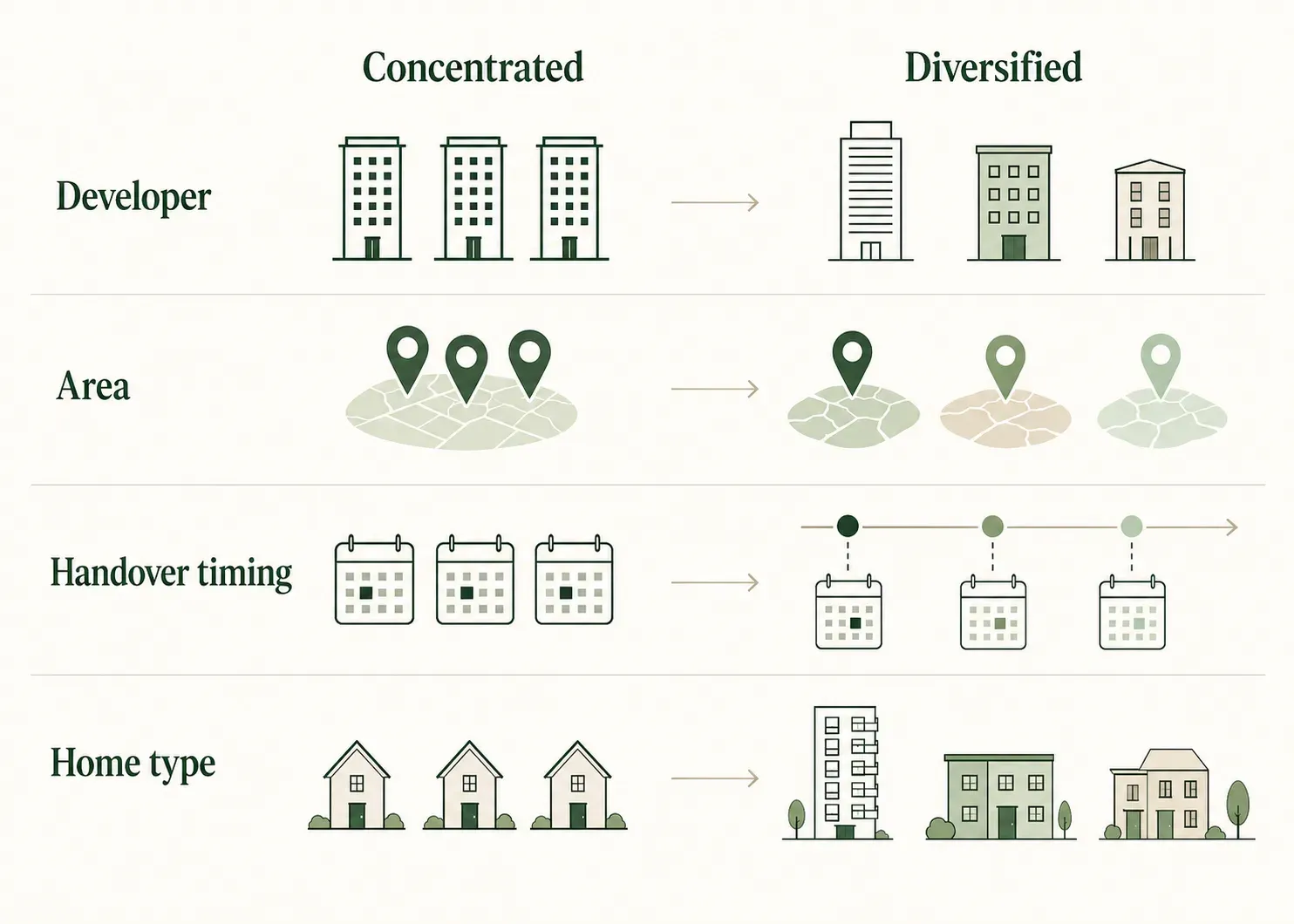
Four axes of diversification matter, and they are largely independent of each other.
- Developer. Each developer carries its own delivery record, balance sheet and project pipeline. Concentrating in one means a single company’s timeline becomes your timeline. Spread across developers with different track records, and use the off-plan developer guide to judge delivery history rather than brand noise.
- Area and community. A community can be oversupplied exactly when your unit completes, softening both rent and resale. Holding two units in different communities, with different tenant audiences and supply pipelines, reduces the chance that one local glut hits your whole position. The areas guide sets out what each community is actually for.
- Handover timing. This is the most overlooked axis. Two units completing twelve months apart spread the heavy completion costs across two budget years and let the first unit start producing rent before the second one’s balance is due. Two units completing together do the opposite.
- Home type and price band. A compact one-bedroom aimed at the rental market behaves differently from a family townhouse aimed at end users. Mixing band and home type spreads your risk across different kinds of tenants and buyers. An entry-level position is covered in our guide to off-plan property under AED 1 million in Dubai.
You do not need to spread across all four axes on every unit. You do need to avoid stacking the same exposure on every unit.
Set the weaker and stronger versions of each axis side by side:
This is a way to read your own combination rather than a sequence to buy. Two buyers with the same budget can build a strong or a weak structure from the same axes, depending only on how they spread them.
How do you sequence payment plans and cash flow?
A portfolio lives or dies on its payment-plan schedule. Off-plan property produces no rent during construction, so until units hand over and get rented out, money only goes out with nothing coming back. What you want to avoid is several large handover payments all falling due at the same time.
The closing payment is where most of the money sits, so the schedule of those closing payments is the schedule that matters.
Three current Projectory listings put real numbers on the same pattern. They are illustration rather than a set to buy, and their different price points, areas, developers and handover years show how the cash flows interact:
- Park Five by Deyaar in Dubai Production City, apartments from AED 611,000 on a 10/40/50 plan, handover December 2027.
- Golf Hillside by Emaar in Dubai Hills Estate, apartments from AED 1,470,000 on a 10/70/20 plan, handover December 2028.
- DAMAC Islands 2 in Dubailand, four to seven-bedroom homes from AED 2,750,000 on a 20/55/25 plan, handover June 2030.
Three developers, three communities, three handover years, around AED 4.83M of entry pricing in total. What counts is how the closing balances and registration fees fall across the calendar. The 4% Dubai Land Department fee, due near each unit’s initial Oqood registration, works out at AED 24,440, AED 58,800 and AED 110,000 respectively. The handover balances, the largest single payment on each unit, land in three different years: about AED 305,500 in late 2027 on Park Five, AED 294,000 in late 2028 on Golf Hillside, and AED 687,500 in mid-2030 on DAMAC Islands 2.
Line all three of those payments up in the same few months and you owe roughly AED 1,287,000 at once with nothing yet earning. Spread across 2027, 2028 and 2030, Park Five can complete, be tenanted and begin contributing rent in 2028, before Golf Hillside’s balance is due and well before the larger DAMAC Islands 2 balance in 2030. Same three projects, same prices: the only thing you changed was the order they complete in, and that is what makes the schedule fundable. Your own combination needs the same test against your cash flow and timing.
What are the exit routes, and how do they interact?
Off-plan returns can come from different routes, and they are not interchangeable. Keep them separate, and never add them into a single headline figure.
- Construction-stage capital appreciation is the possible change in value between purchase and handover. It is unrealised until you sell or assign.
- Pre-handover assignment is reselling the contract before completion. It depends on the developer’s rules, a minimum payment threshold, a no-objection certificate and a fee, plus a buyer willing to take the assignment. It is a possible exit, not a guaranteed one.
- Post-handover rental income begins only after completion, handover and tenancy. Gross yield is the rent before costs; net yield is what remains after service charges, vacancy, management and maintenance, and net is the figure that matters. Our ROI guide works through the gross-to-net gap.
- Post-handover resale depends on completed comparable transactions in the building and community.
At portfolio level, stagger the exits the same way you stagger the handovers, so you are never forced to assign or sell everything into the same market window. A plan that only works if every unit appreciates, assigns cleanly and rents immediately has almost no margin of safety. A resilient plan survives one of those assumptions weakening.
What costs and checks apply across the portfolio?
Costs that look small on one unit compound across several, so budget for the 4% registration fee and the Oqood or initial-registration admin per unit, the post-handover service charge per square foot on every completed unit, any mortgage and financing cost if you are leveraged, and the exit costs of agency commission and any assignment or transfer fees. Service charges in particular run for the life of ownership and vary sharply with the amenity load, so estimate them per unit using our guide to service charges on off-plan property in Dubai. For leveraged Dubai purchases, our off-plan mortgage guide compares current bank routes, lending thresholds and finance costs.
Before adding each unit, confirm in writing the current price and live availability, the full payment schedule including the handover balance, the expected service charge, the handover date and what happens if it moves, and the registration, Oqood and escrow position for Dubai projects, or the equivalent evidence in the relevant emirate. Outside Dubai, confirm the local authority and process rather than assuming Dubai Land Department rules apply.
Treat each emirate as its own market, not another line on the same Dubai checklist. Dubai has the deepest visible transaction and registration ecosystem, with the most published price evidence to test a resale or rent assumption against. Abu Dhabi, Ras Al Khaimah and Sharjah can follow different registration, ownership and authority processes, and each has its own depth of comparable evidence and tenant demand.
Build the schedule first, stress-test it against a slow handover and a soft rent, and add each unit only when the schedule still holds.
Frequently asked questions
How many properties do you need for an off-plan portfolio?
A portfolio starts at two, but the count matters less than capacity. The real test is whether you can fund every overlapping payment plan through to handover, and carry the units if rent or timing disappoints, without being forced to sell one early. Add a unit only when the cash-flow schedule still holds under a delayed handover.
Can you build an off-plan portfolio with a small budget?
Yes, by sequencing rather than buying at once. Entry-level off-plan units in the UAE start well below AED 1 million, so a portfolio can be built one unit at a time, using staggered handovers so the first unit can begin contributing before the next balance is due. The thing to test is whether you can keep funding each plan through to handover.
How do you build an off-plan portfolio under AED 5M in Dubai?
You build it by sequencing the purchases rather than spending to a target. Around AED 5M is enough to hold three current Dubai off-plan units across different price points, for example an entry apartment from around AED 600,000, a mid-range apartment around AED 1.5M and a larger home around AED 2.75M, provided their handover dates are staggered so the closing balances and 4% registration fees fall in different years rather than the same quarter. What you need to be sure of is whether you can fund every overlapping payment plan through to handover, so let the earliest unit complete and begin contributing before the next balance is due.
How do you reduce risk across an off-plan portfolio?
Spread four exposures that are largely independent: the developer, the area or community, the handover date and the home type or price band. Concentrating all units with one developer, in one community, completing in one quarter turns a single problem into a portfolio-wide one. Diversifying those axes is what stops the holdings all moving the same way.
Is it better to buy multiple cheaper off-plan units or one larger property?
There is no universal answer; it depends on your cash flow, the handover timing, tenant demand and exit depth. Several smaller units spread your risk across different communities, tenants and buyers and let you stagger handovers, but they multiply the fixed costs: a 4% registration fee, a service charge and management on each unit. One larger property is simpler to hold and concentrates your capital in a single asset, though it ties your outcome to one community’s rent and resale depth. The right route is whichever one’s cash-flow schedule and exit options you can actually fund and test, rather than whichever shows the lower headline entry price.
Does an off-plan portfolio generate income before handover?
No. Off-plan property earns no rental income during construction. Until each unit completes, hands over and is rented out, money is only going out, with nothing coming back. Any return before handover would come from capital appreciation or a pre-handover assignment, neither of which is rental income and neither of which is guaranteed.
Should you sell off-plan units before or after handover?
It depends on the route and the market, and the portfolio-level point is to stagger the decision. Pre-handover assignment can release capital earlier but depends on developer rules, a payment threshold, a no-objection certificate and a willing buyer. Post-handover resale needs completed comparable sales. Spreading exits across different windows avoids being forced to sell everything into one market.
Sources and useful references
- Off-plan property investment in the UAE: complete investor guide
- ROI on off-plan property in Dubai
- The complete guide to off-plan property in Dubai
- Service charges on off-plan property in Dubai
- Best areas to buy off-plan property in the UAE
- Dubai Land Department: initial sale registration and fees
- Dubai Land Department
Browse current UAE off-plan projects on Projectory by area, developer, starting price, payment plan and handover date, then test each one’s payment schedule and return assumptions before adding it to a portfolio.
About the Projectory Team
Projectory’s editorial content is created and reviewed by its founders, who bring more than 30 years of combined experience brokering, buying, developing and selling property in the UAE.
In this guide series
- Buying GuidesDubai Off-Plan Mortgage: Which Banks Lend and What It Costs
- Investment & ReturnsHow to Sell Dubai Off-Plan Property Before Handover: Assignment Sales Explained
- Buying GuidesCommon Off-Plan Mistakes in Dubai and How to Avoid Them
- Investment & ReturnsOff-Plan Property Tax Benefits: Why the UAE Draws Investors
- Buying GuidesGolden Visa Property Documents in Dubai: Oqood, SPA & Evidence Explained
- Buying GuidesGolden Visa Dubai Through Property: 2026 Guide
- Investment & ReturnsCapital Appreciation in Dubai Off-Plan Property
- Buying GuidesOff-Plan Developer Bankruptcy Dubai: What Buyers Need to Know
- Investment & ReturnsROI on Off-Plan Property in Dubai: Current Projects, Prices & Track Record
- Buying GuidesIs Off-Plan Property Safe in Dubai? Buyer Safety Guide