
Dubai Off-Plan Handover Mortgage Checklist: Final 12 Months
A month-by-month Dubai off-plan handover mortgage checklist covering pre-approval, valuation, final approval, documents, drawdown and handover costs.
What’s in this guide:
- The final 12 months at a glance
- 12 to 9 months: build the funding plan
- 9 to 6 months: secure mortgage pre-approval
- 6 to 3 months: align the bank with the project
- The final 90 days: move to final approval
- Cash to keep outside the mortgage
- Your handover mortgage document file
- Handover week: confirm the money and paperwork
- If the handover date moves
- Common last-minute problems
- Frequently asked questions
The final year of an off-plan purchase turns a future payment into a financing deadline. Start 12 months before expected handover where possible. Your bank needs time to assess your finances, approve the project and unit, arrange a valuation and coordinate payment with the developer. Starting early also gives you room to correct a credit-report error or build extra cash if the valuation comes in low.
For current bank programmes, lending limits, rates and a full cost example, read our Dubai off-plan mortgage guide. This checklist concentrates on timing and execution.
Quick answer
- Begin the mortgage conversation about 12 months before expected handover.
- Check the expiry date on every approval and valuation.
- Keep cash for your contribution, any valuation shortfall and handover costs.
- Ask the bank and developer to confirm the final-payment sequence in writing before you sign the facility documents.
The final 12 months at a glance
Check every approval, valuation and document for an expiry date. A revised handover schedule can push the transaction beyond them.
12 to 9 months: build the funding plan
Open your SPA and write down the purchase price, amount paid, remaining construction instalments and handover balance. Match them against the developer’s latest statement and query any missing payment.
Then decide how much finance you expect to request. The Central Bank’s published ceiling for a property being purchased off-plan is 50% of value. A bank can approve less after reviewing your finances, the project and its valuation.
Suppose you bought for AED 2 million and plan to finance the remaining AED 1 million. If the bank values the property at AED 1.8 million, 50% is AED 900,000. You would need another AED 100,000, plus fees and handover costs. Give that possible shortfall its own savings line.
Check your credit file early
Download your Etihad Credit Bureau report and read every entry. It records loans, credit cards, bills, payment history and the last salary reported to the bureau. If anything is wrong, use the bureau’s data-correction service while you still have time to resolve it.
List every monthly commitment, including credit-card limits and loans you expect to clear. The Central Bank’s published maximum debt burden ratio is 50% of gross salary and regular income, although a bank may approve less. Build the plan around income and savings you can evidence.
9 to 6 months: secure mortgage pre-approval
Speak to at least two suitable lenders or a regulated mortgage adviser. Ask each one the same questions:
- Is the developer and project currently eligible?
- At what construction or payment stage can the mortgage proceed?
- How long will pre-approval remain valid?
- When will the valuation and final assessment begin?
- How will the bank coordinate payment with the developer?
Pre-approval shows the likely loan amount and catches affordability issues early. It can still change before drawdown if your finances or the property change. Validity periods vary: ADCB, for example, advertises a 12-month off-plan pre-approval, subject to credit assessment and ending at handover if that arrives sooner. Set a renewal reminder six weeks before your own approval expires.

Build the document file once
Salaried applicants commonly need a passport, visa and Emirates ID, a recent salary certificate, payslips where income varies and six months of bank statements. Self-employed applicants may also need a trade licence, company documents, personal and company statements and two years of audited accounts. Keep the SPA, Oqood, payment receipts and developer statement in the same file.
Keep clean PDF copies in one folder with consistent filenames. Replace documents as they expire or become too old for the bank.
If you live abroad, confirm whether the bank will accept remote signing or requires a UAE visit, and whether a power of attorney can be used for any stage. Our guide to buying off-plan property in Dubai from abroad covers the wider purchase process.
6 to 3 months: align the bank with the project
Check the official completion percentage through the DLD Project Status Enquiry and compare it with the developer’s update and the date in your SPA.
Ask your mortgage contact to reconfirm that the project and your exact unit remain eligible. Bank thresholds differ. Mashreq’s published off-plan programme, for example, requires at least 35% verified construction and at least 50% of the SPA price paid by the buyer for an eligible project. Another lender may use a different project list or timing.
Send the bank an updated property pack:
- signed SPA, addenda and Oqood;
- developer statement and proof of payments;
- latest construction or handover notice;
- unit details and developer mortgage-team contact.
Ask who will handle the developer’s side. The bank may need valuation access, a developer eNOC and signed documents before drawdown. Introduce both contacts by email with the unit number, deadline and balance, then send the bank current income and liability documents.
The final 90 days: move to final approval
Send the completion or handover notice and latest statement to the bank immediately. Ask for a written list of outstanding conditions and who owns each one.
The bank will arrange its own valuation. Central Bank mortgage rules require an independent on-site valuation before an irrevocable lending commitment. The valuer works for the bank’s credit process, so a developer price, broker estimate or online valuation cannot replace it.
When the bank issues the final offer, compare it with your pre-approval:
- approved loan amount;
- rate, repayment, term and first-payment date;
- fees and early-settlement terms;
- required insurance or takaful;
- conditions that must be completed before drawdown.
The bank should give you a Key Facts Statement explaining the main terms, rates, fees and warnings. UAE consumer-protection standards also provide a five-complete-business-day cooling-off period for regulated financial products, unless you sign a permitted written waiver. Build that time into the schedule instead of assuming the facility can be signed and released on the same day.
Mortgage registration comes next. DLD supports ordinary registration and provisional registration for properties recorded through Oqood. For a provisional-sale mortgage, DLD lists a developer eNOC among the requirements. Ask the bank to confirm the route, outstanding documents, transfer date and amount, fees and the ownership certificate you will receive.
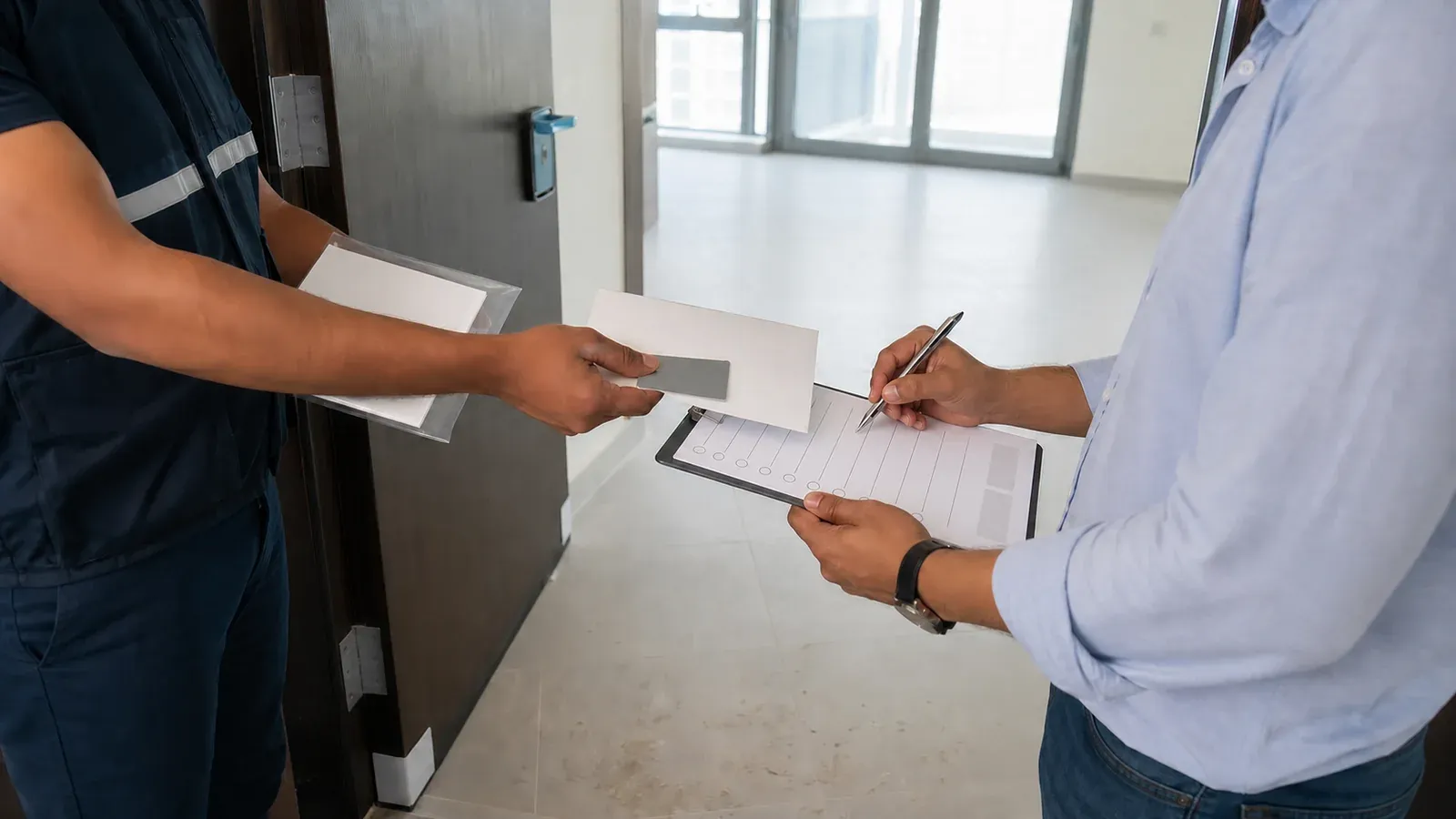
Cash to keep outside the mortgage
- Your final contribution: the portion of the developer balance the bank will not finance.
- A valuation shortfall: extra cash if the bank valuation supports a smaller loan than expected.
- Mortgage costs: valuation, processing, insurance or takaful and any required account costs.
- DLD and trustee costs: mortgage registration, certificate or title issuance and service-partner charges where applicable.
- Developer charges: any documented administration, eNOC or handover charges allowed under your agreement.
- Ownership costs: service charges, utility and cooling deposits, snagging, furnishing and moving.
Our DLD fee guide explains the registration costs in detail. Use the service-charge guide to estimate the first ownership bill.
Keep the reserve accessible until the bank confirms that drawdown and registration have completed.
Your handover mortgage document file
Save every bank and developer confirmation as a PDF. Written records keep dates, figures and responsibilities clear.
Handover week: confirm the money and paperwork
- Match the figures. The developer statement, your contribution and the bank’s approved drawdown should add up to the final amount due.
- Transfer your contribution. Use the payment instructions confirmed by the developer and keep the receipt.
- Confirm bank drawdown. Obtain evidence of the amount, beneficiary and transfer date.
- Complete mortgage registration. Keep the DLD registration output, whether it is a title document or provisional Oqood mortgage certificate.
- Collect the handover pack. Keep the keys, access cards, parking and meter details and signed handover form.
- Check the first mortgage payment. Confirm its date, amount, collection account and whether any insurance payment is separate.
Inspect the property before signing the final condition report. Photograph defects and submit them through the developer’s stated process.
If the handover date moves
Tell the bank as soon as the completion date changes. Check whether the pre-approval, valuation, final offer, income documents or insurance will expire. You may need updated statements, a fresh salary certificate, renewed company documents or another valuation. Keep following the SPA payment schedule, obtain the revised date in writing and leave the mortgage reserve liquid.
Common last-minute problems
Most of these problems can be solved three months out. They become expensive when discovered days before final payment.
Frequently asked questions
When should I apply for a mortgage on a Dubai off-plan property?
Begin lender discussions around 12 months before expected handover and aim for pre-approval during the following three months.
Can a bank reject the mortgage after pre-approval?
Yes. Final approval still depends on your current finances, project and unit eligibility, legal checks and the valuation.
Can the mortgage pay the handover instalment?
It can fund an eligible part of the outstanding price. Confirm the amount and drawdown timing before the developer’s deadline.
What happens if the bank values the property below my purchase price?
The loan is normally calculated against the bank’s accepted value and lending limit. A lower figure increases the cash you need. Ask about the valuation-review process and keep money available for the gap.
Can a mortgage be registered before the title deed is issued?
DLD provides a provisional mortgage-registration route for properties recorded through Oqood. The bank and developer will coordinate the correct route for the property’s status, including any developer eNOC required.
When does the first mortgage repayment start?
The date comes from the final finance agreement. Confirm the amount, due date and collection account before drawdown.
The final check
A smooth handover mortgage comes from three aligned files: your finances, the bank approval and the developer’s completion paperwork. Check them together every month during the final quarter.
Use this guide alongside our complete Dubai off-plan buying guide and RERA and escrow protection guide when reviewing the project and your purchase documents.
Official references
About the Projectory Team
Projectory’s editorial content is created and reviewed by its founders, who bring more than 30 years of combined experience brokering, buying, developing and selling property in the UAE.
In this guide series
- Buying GuidesDubai Off-Plan SPA: What Buyers Should Check
- Buying GuidesHow to Track Your Off-Plan Construction Progress in Dubai
- Buying GuidesRERA and Escrow Protection for Dubai Off-Plan Buyers
- Buying GuidesDLD Waivers in Dubai: How Developers Reduce Off-Plan Costs
- Buying GuidesService Charges on Off-Plan Property in Dubai: What to Check
- Buying GuidesUnderstanding DLD Fees for Off-Plan Property in Dubai